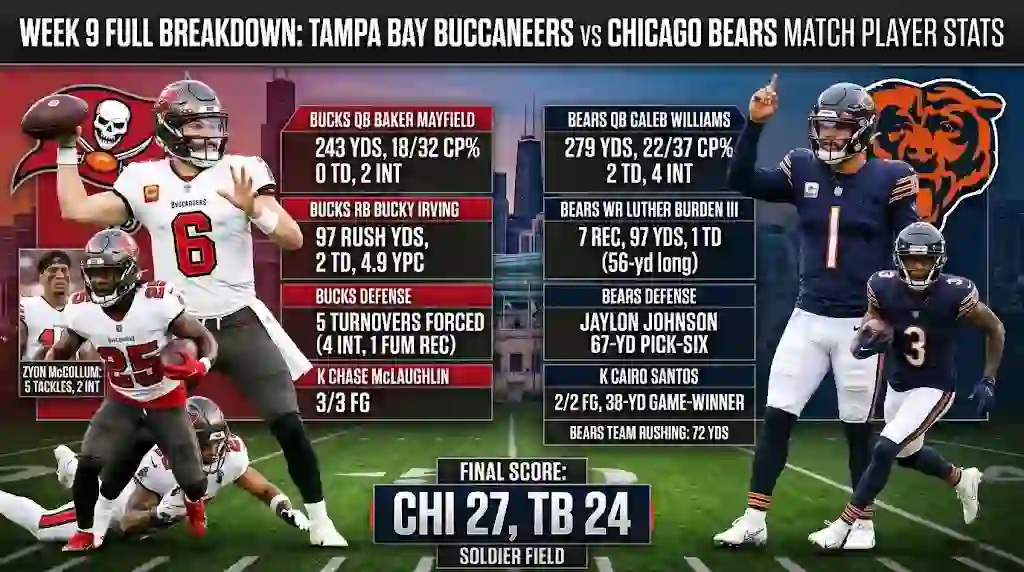
A 27-24 final score tells you who left Soldier Field happy. It tells you almost nothing about how a Sunday Night Football thriller actually unfolded. The tampa bay buccaneers vs chicago bears match player stats reveal a strange game: the losing side forced five turnovers, out-rushed its opponent and still came up one kick short.
Chicago quarterback Caleb Williams threw for 279 yards and two touchdowns, yet he was also intercepted four times. Tampa Bay running back Bucky Irving punished the Bears for 97 yards and two scores, while his quarterback Baker Mayfield fought through two costly picks, one of them a 67-yard return touchdown for the home team.
This breakdown walks through every unit that shaped the result. You will see which individual performances carried each roster, which numbers looked better than they were, and what the 2026 stat lines suggest for both teams down the stretch.
Why the Buccaneers vs Bears Match Player Stats Keep Producing Wild Outliers
Tampa Bay plays in the NFC South and Chicago plays in the NFC North. Different divisions mean limited meetings, and limited meetings mean limited film. Neither coaching staff arrives with a deep library of recent tendencies to attack, so both lean on disguise, pre-snap movement and creative pressure to create doubt.
That uncertainty tends to bend individual stat lines away from season norms. Defenders jump routes they have not seen in a while. Quarterbacks press for big plays because the safe, scripted answers feel less reliable. Special teams, which often get ignored in preview articles, suddenly carry real weight in the field position battle.
Week 9 followed that script closely. Seven total giveaways changed hands across the two teams, a 91-yard return touchdown disappeared because of a holding flag, and a punt that traveled only 24 yards handed the visitors a short field. Nobody could call this a clean, predictable game.
If you read the tampa bay buccaneers vs chicago bears match player stats only through the score, you miss the real story: a chaotic, mistake-driven contest decided by a final-second field goal.
Quarterback Showdown: Passing Numbers in the Tampa Bay Buccaneers vs Chicago Bears Match Player Stats
Both signal-callers produced numbers that deserve context. Williams generated more yardage and more touchdowns. Yardage alone favored Chicago, but the decision-making column told a different tale.
Completion Percentage and Passing Yardage Breakdown
Mayfield completed 18 of 32 attempts for 243 yards, a 56.3 percent clip, and Tampa Bay’s passing game still posted a season-high mark in net passing yards according to the team’s postgame report. Several of his biggest gains came off schedule. A scramble-drill throw to running back Kenny Gainwell covered 44 yards, and a deep shot to wideout Tez Johnson went for 58.
Williams finished 22 of 37 for 279 yards, a 59.5 percent completion rate, with a long gain of 56 yards. He took one sack and ended the night with a passer rating of 61.5, a figure dragged down almost entirely by the interception column.
Chicago finished with 349 total yards, including 277 net passing yards. Tampa Bay countered with 352 total yards. When two offenses land that close on raw production, the separating factors become turnovers, third-down efficiency and points per possession.
Touchdowns, Interceptions, and Turnover Impact
Williams threw two touchdown passes: a nine-yarder to Rome Odunze on the opening drive and a 56-yard catch-and-run to Luther Burden III on the next series. After that fast start, Chicago’s passing offense sputtered while Tampa Bay’s secondary collected four interceptions.
Mayfield did not throw a touchdown pass, and he gave the ball away twice. Cam Lewis picked him off at the Chicago 26-yard line to end a promising drive. Later, Jaylon Johnson jumped a throw at the Chicago 33 and raced 67 yards for a touchdown that pushed the Bears’ lead to 24-13.
That sequence is the cleanest example of why the tampa bay buccaneers vs chicago bears match player stats cannot be read in isolation. Williams threw twice as many interceptions, yet Mayfield’s single worst throw produced a seven-point swing that rivaled any offensive touchdown on the field.
Running Back Stats: The Ground Game Tampa Bay Won
Chicago’s ground attack never found a rhythm, and the numbers make that obvious. Tampa Bay controlled the line of scrimmage, protected Mayfield with the threat of the run, and kept its offense on schedule whenever the passing game stalled.
Yards Per Carry and Workload
Bucky Irving was the most productive ball carrier in the game. He rushed 20 times for 97 yards, an average of roughly 4.9 yards per attempt, with a long run of 25 yards and two rushing touchdowns. His two-yard scoring run in the third quarter made it 17-13, and his six-yard score in the fourth quarter helped tie the game late.
Gainwell added five carries for 16 yards. Wide receivers Chris Godwin and Emeka Egbuka each took one handoff, and Mayfield kept the ball once for no gain before later scoring the game-tying two-point conversion on a scramble up the middle. Tampa Bay’s rushing total reached roughly 126 yards.
Chicago’s backfield struggled by comparison. D’Andre Swift managed 31 yards on 12 carries, a 2.6 average, and Salvon Ahmed contributed 25 yards on five attempts. Williams chipped in 16 yards on five scrambles. Chicago’s team rushing total landed near 72 yards, nearly 55 yards behind the visitors.
Receiving Production Out of the Backfield
Irving was also a factor as a receiver, catching three passes for around 28 yards according to the Buccaneers’ recap. Gainwell’s two receptions for 50 yards included that 44-yard scramble-drill play, which turned a broken down moment into the longest gain of the first half.
Chicago did not get comparable production from its running backs through the air. The Bears leaned on wideouts and the tight end group for yardage, which narrowed the offense and made it easier for Tampa Bay’s defensive backs to sit on routes once the early lead evaporated.
Wide Receiver and Tight End Numbers in the Buccaneers vs Bears Match Player Stats
The receiving charts show two very different distribution models. Chicago’s offense generated explosive plays through a few playmakers. Tampa Bay spread the ball across several targets and relied on volume at the tight end position.
Tez Johnson and Emeka Egbuka vs Luther Burden III and Rome Odunze
Luther Burden III led all receivers in the game with seven catches for 97 yards and a touchdown. His 56-yard score showcased the yards-after-catch ability that made him a premium draft pick, as he slipped multiple tackles on a four-play touchdown drive.
Rome Odunze added four receptions for 60 yards and a touchdown, including that nine-yard score on Chicago’s opening possession. Together, the two Bears wideouts accounted for 157 of Williams’ 279 passing yards, which is more than half of the team’s production through the air.
Tampa Bay’s top receiver by yardage was Tez Johnson, who turned just two catches into 76 yards thanks to the 58-yard deep ball. Emeka Egbuka caught three passes for 38 yards, Gainwell collected 50 yards on two receptions, and Chris Godwin added two catches for 16 yards. The Buccaneers’ yardage came in chunks rather than steady accumulation, which partly explains the 2-for-12 third-down performance.
Tight End Production and Red Zone Usage
Tampa Bay tight end Cade Otton quietly led the team in receptions with four catches for 25 yards. He worked underneath routes, moved the chains on early downs and gave Mayfield a dependable outlet. His low yardage total is a reminder that reception counts and yardage totals measure different things.
Chicago’s Colston Loveland caught two passes for 10 yards, a modest line for a high-profile young tight end. The Bears clearly prioritized the perimeter against a Buccaneers defense that was happy to play tight coverage on the interior.
Red zone usage mattered for the visitors too. On fourth-and-goal from the four-yard line in the second quarter, Tampa Bay took a delay of game penalty when Chicago would not jump offside and settled for a 27-yard field goal. That decision cost the Buccaneers a potential touchdown and became one of the quiet swing moments of the night.
Defensive Player Stats: Interceptions, Tackles, and Game-Changing Turnovers
The defensive side of the tampa bay buccaneers vs chicago bears match player stats is where the game becomes truly unusual. Tampa Bay forced five turnovers and still lost, a result that almost never happens in the modern NFL.
Zyon McCollum and the Secondary Takeaway Show
Cornerback Zyon McCollum was the best defender on the field. He recorded five total tackles and two interceptions, one at the Tampa Bay 18-yard line and another at the Chicago 43, bringing his season total to four. Safety Tykee Smith added an interception at the three-yard line that erased a Chicago scoring chance, and linebacker Alex Anzalone grabbed another in the third quarter, returning it six yards.
That makes four interceptions of Williams from four different moments in the game. Tampa Bay’s defense effectively turned the Bears’ best drives into empty trips.
On the other side, Chicago defensive back Cam Lewis finished with six total tackles and an interception. Jaylon Johnson’s 67-yard pick-six did the most damage of any single defensive play in the game and kept Chicago ahead when Tampa Bay was beginning to find a pulse.
Pass Rush, Tackles, and the Late Fumble
Tampa Bay’s pass rush produced one sack of Williams, and the Bears’ front answered in a key fourth-quarter sequence. Back-to-back sacks of Mayfield on first and second down forced a Buccaneers punt and showed how Chicago’s front could swing momentum back.
Then came the play that changed everything for Tampa Bay. Defensive back Keionte Scott forced a fumble, and Ifeatu Melifonwu recovered it at the Chicago 21-yard line, returning it four yards. Two snaps later, Irving punched in his second touchdown, and Mayfield’s two-point scramble tied the score at 24.
Special Teams Stats That Shaped Field Position and the Finish
Special teams delivered more drama than most fans expected. Chicago’s Zavion Thomas returned a kickoff 40 yards to set up the Bears’ first touchdown drive. Later, he appeared to take a return 91 yards for a score, but a holding penalty on D’Marco Jackson wiped it off the board.
Tampa Bay’s special teams unit answered with a big play of its own. Miles Killebrew got a hand on a Chicago punt, limiting it to 24 yards and handing the Buccaneers possession at the Chicago 49-yard line. That sequence illustrates how a single special teams effort can flip field position without a single offensive snap.
Kicker Chase McLaughlin was perfect for Tampa Bay, converting field goals of 27, 21 and 35 yards. Chicago’s Cairo Santos was also perfect, hitting from 25 yards and then delivering the 38-yard game-winner as time expired. The finish was a reminder that a three-point game can come down to one swing of a leg.
Head-to-Head Tampa Bay Buccaneers vs Chicago Bears Match Player Stats Comparison Table
Seeing the leaders side by side makes the pattern easy to spot. The table below compares the most important individual numbers from this matchup.
| Category | Buccaneers Leader | Stat | Bears Leader | Stat |
| Passing Yards | Baker Mayfield | 243 | Caleb Williams | 279 |
| Completion % | Baker Mayfield | 56.3% (18/32) | Caleb Williams | 59.5% (22/37) |
| Passing TDs | Baker Mayfield | 0 | Caleb Williams | 2 |
| Interceptions Thrown | Baker Mayfield | 2 | Caleb Williams | 4 |
| Rushing Yards | Bucky Irving | 97 (20 att.) | D’Andre Swift | 31 (12 att.) |
| Rushing TDs | Bucky Irving | 2 | Bears (team) | 0 |
| Top Receiver (Yards) | Tez Johnson | 76 (2 rec.) | Luther Burden III | 97 (7 rec.) |
| Receiving TDs | Buccaneers (team) | 0 | Burden III / Odunze | 1 each |
| Defensive Highlight | Zyon McCollum | 5 tackles, 2 INT | Cam Lewis | 6 tackles, 1 INT |
| Field Goals | Chase McLaughlin | 3/3 | Cairo Santos | 2/2 |
| Total Yards | Buccaneers | 352 | Bears | 349 |
| Third Down | Buccaneers | 2/12 | Bears | Not reported |
The table confirms the strange duality of the night. Tampa Bay won the rushing battle and the takeaway battle on paper, and both kickers were perfect. Chicago won the one that matters most: the scoreboard, helped by a defensive touchdown and a clean closing drive.
Latest Updates: What These Player Stats Mean Going Forward
The result leaves Tampa Bay at 3-6 on the season, a record that makes every remaining game feel urgent. The Buccaneers’ offense showed it can sustain drives, protect the ball more often than not and generate explosive plays, but the two interceptions and the third-down struggles remain fixable problems rather than long-term flaws.
For individual players, Bucky Irving’s two-touchdown showing reinforces his role as the engine of Tampa Bay’s offense, and Zyon McCollum’s four interceptions on the year are putting him squarely in the conversation as one of the most opportunistic corners in the league this season. Tez Johnson’s deep-threat ability is another encouraging sign for a passing game that needs more vertical plays.
Chicago leaves with a win but also with a warning. Williams’ four interceptions are a red flag despite his two touchdown throws and a strong supporting cast. Burden III and Odunze are developing into a legitimate one-two punch, but the Bears cannot expect to survive many nights with a minus-three turnover margin, as they did here.
For anyone tracking fantasy football or player props, the message is simple. Irving is a must-start back when the Buccaneers’ offensive line is healthy, Burden III is climbing the target ladder in Chicago, and McCollum is a high-impact defender for league formats that reward takeaways.
The Bottom Line on the Tampa Bay Buccaneers vs Chicago Bears Match Player Stats
Raw numbers rarely tell the full story, and this game is a perfect example. The tampa bay buccaneers vs chicago bears match player stats show a Buccaneers team that forced five turnovers, ran the ball better and matched Chicago in total yardage, yet still lost on a last-second kick.
Chicago won because it capitalized on three decisive moments: two quick touchdown strikes to start the game, a 67-yard interception return touchdown, and a calm game-winning field goal. Tampa Bay lost because of two critical interceptions, a 2-for-12 night on third down, and a handful of missed chances inside the red zone.
For readers who follow this matchup closely, the biggest lesson is that turnover totals do not always translate directly to wins. Efficiency, timing and special teams execution carry just as much weight on Sundays. Keep these figures in mind the next time these two franchises meet, because the Week 9 numbers will serve as the benchmark
Sources for the 2026 data: official Tampa Bay Buccaneers and Chicago Bears game-day box scores, the Buccaneers’ postgame report, and Football Database box score listings. Verify final figures against the NFL’s official stat pages before publishing.