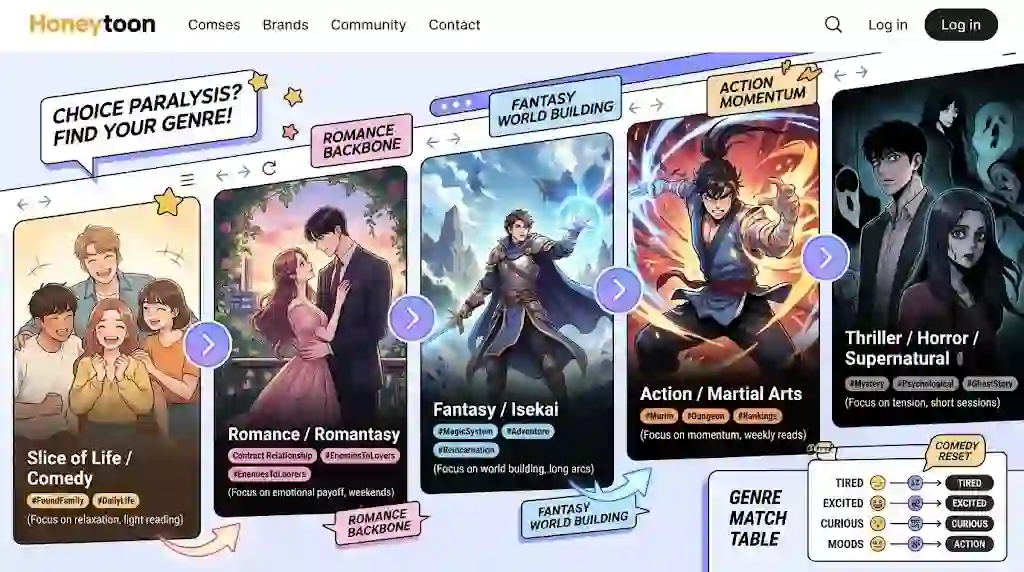
You open the catalog, see four hundred covers, and close the tab without reading a page. Choice paralysis is the real reason new readers never start. This guide breaks a Honeytoon comic catalog down by genre, mood, and reading rhythm, so you can pick a series in five minutes and actually finish it.
Why Genre Beats Ranking When You Choose a Honeytoon Comic
Bestseller lists measure other people’s taste, not yours. A top-ranked title might be a 300-episode martial arts epic when you want a quiet romance you can finish in a weekend.
Genre narrows the field to something you can judge. It tells you the emotional payoff, the pacing, and the commitment length before you invest a single evening.
Use rankings as a tiebreaker, never as a starting point. Readers who choose by genre finish more series, and finished series teach you what you genuinely enjoy.
Romance: The Genre That Runs the Webtoon Charts
Romance is the backbone of vertical comics for a simple reason. Emotional stakes arrive in chapter one, which makes the format work on a phone screen.
Common patterns show up fast:
- Contract relationships that start fake and turn real.
- Second-chance stories with an ex who returns at the worst moment.
- Workplace romance where power imbalance drives the tension.
- Hidden identity plots, from secret heirs to double lives.
Look for completed romance titles first. Romance endings matter more than romance openings, and a finished series proves whether the writer could land the plane.
Fantasy and Isekai: Big Worlds, Long Series
Fantasy gives an artist room to build. Vertical scroll lets a Honeytoon comic show a full city, a magic circle, or a battlefield in one unbroken image.
Expect longer runs. Fantasy rarely wraps in twenty episodes, so check the episode count before you start. Isekai, reincarnation, tower climbing, and academy settings dominate the lane.
Fantasy also overlaps romance heavily. The romantasy blend drives global webtoon charts because it delivers both scale and intimacy, and readers who enjoy one usually enjoy the other.
Action and Martial Arts: Momentum Over Everything
Action lives on rhythm. A good action chapter ends mid-swing, and the scroll format makes that cliffhanger hit harder than any page turn.
Three subcategories cover most of the shelf:
- Murim and cultivation stories with ranked power levels.
- Dungeon and system stories built around stats and quests.
- Revenge arcs with a long fuse and a satisfying payoff.
Action titles reward readers who like weekly anticipation. Read two chapters before judging, because early fights often look small compared with what comes later.
Drama and Office Stories: Realism With Teeth
Drama trades magic for consequences. Family money, career pressure, and social class give a Honeytoon comic stakes you can recognize from your own life.
Office settings work especially well. Small rooms force close framing, and close framing makes expression and silence do the emotional work.
Modern drama often sits closer to realism than readers expect. If you enjoy character studies more than plot twists, start here and skip the fantasy shelf entirely.
Thriller, Horror, and Supernatural: Short, Sharp Sessions
Thriller and horror titles are usually shorter, and that is their advantage. A tight ten-episode arc reads in one sitting and stays with you longer than a mid-tier 90-episode epic.
- Crime puzzles reward readers who like to guess.
- Ghost stories use empty space and silence for tension.
- Psychological thrillers lean on unreliable narrators.
Read these in daylight if you spook easily. Also avoid reading three horror arcs back to back, because the tension stops landing once your nerves adjust.
Slice of Life and Comedy: The Reset Button
Slice of life gets dismissed as low stakes, which misses the point. These series work as a palate cleanser between heavy arcs.
Food stories, school life, found families, and quiet humor fill this shelf. Episodes feel light because nothing catastrophic happens, and that lightness is exactly what a reader needs after a brutal thriller.
Keep one comedy on your shelf at all times. Rotating a Honeytoon comic comedy arc between serious reads prevents the fatigue that kills long reading streaks.
Mature Titles: What the 18+ Label Actually Means
Mature sections exist on most comic platforms, and the label deserves plain language. It usually means adult romance, explicit scenes, heavier violence, or complex themes gated behind age verification.
Handling differs by platform. Responsible ones separate the adult catalog, verify age, and label ratings before a chapter loads. Careless ones mix everything into one feed.
Verify your region’s rules, use the age gate as designed, and keep mature titles in a separate profile if other people share your device. A clear boundary keeps the whole catalog usable.
A Genre Match Table: Mood to Series Type
Use this table when you know how you feel but not what to read.
| Your Mood | Try This Genre | What to Expect | Time Commitment |
| Wound up after work | Comedy or slice of life | Light episodes, low stakes | 10 to 15 minutes |
| Want to feel something | Romance drama | Slow burn, high payoff | One weekend |
| Crave momentum | Action or martial arts | Fights, cliffhangers | Weekly following |
| Need escape | Fantasy or isekai | World building, long arcs | Months |
| Want a puzzle | Thriller or mystery | Clues, unreliable narrators | One sitting |
| Miss real life | Office or family drama | Class, money, ambition | A few evenings |
Print it mentally, not literally. The point is to shorten the gap between mood and first chapter.
How to Test a Honeytoon Comic Genre in One Evening
Genre tests beat reviews because they measure your reaction, not someone else’s.
Read the first three chapters of one title from two different genres. That is roughly forty minutes total. Then answer one question honestly: which one did you want to continue?
Most readers discover their taste skews differently from their assumptions. Someone convinced they love action often lands on drama, because dialogue carries more weight than spectacle on a small screen.
Write your answer down. A three-line note about what worked becomes your filter for the next ten series.
Trope Literacy: Reading the Tags Like a Local
Tags look like clutter until you learn the vocabulary. Then they become the fastest search tool on the platform.
- Enemies to lovers signals conflict before intimacy.
- Slow burn promises payoff in the final third.
- Regression and rewind mean the lead restarts life with knowledge.
- Found family swaps blood ties for chosen ones.
- Possessive lead warns of a dominant romantic archetype.
Learn eight tags and you can predict the emotional shape of a Honeytoon comic before reading a panel. That is not spoiling the story. It is choosing the experience you want tonight.
Tags also protect your time in a way rankings never can. A reader who dislikes love triangles can filter them out in one click, and a reader who wants nothing but slow burns can build a shelf of them in minutes. That filter turns a long browse into a shortlist. It also makes recommendations sharper, because you can describe your taste with three words instead of a paragraph of apology.
Genre Fatigue: When to Switch and When to Stay
Reading three revenge arcs in a row flattens the impact of all three. Fatigue is a signal, not a flaw in your taste.
Switch genres when a plot beat feels predictable twice in a row. Stay with a genre when the characters still surprise you, even if the setting repeats.
Rotation works better than abandonment. Keep one light series, one heavy series, and one wildcard open, then move between them as your mood shifts. Hold a shortlist of five titles from five different shelves, so the next pick is already waiting when one genre goes flat. A steady Honeytoon comic habit survives the slump that ends most reading streaks.
Frequently Asked Questions
Which Honeytoon comic genre is most popular?
Romance leads most webtoon platforms, often paired with fantasy in romantasy titles. Action and martial arts follow closely, and both draw readers who prefer weekly anticipation over completed arcs.
What is the best Honeytoon comic genre for someone new to webtoons?
Start with a completed romance or drama series. These genres explain themselves in the first three chapters, so you learn the vertical scroll format without decoding a complex magic system.
Do I need to read a Honeytoon comic genre in order?
No. Each genre shelf stands alone. Choose by mood, and read any completed series inside a genre without prior context.
Is a Honeytoon comic with an 18+ label different from the general catalog?
Yes. Mature titles sit behind age verification and carry heavier themes, while the general catalog stays available to all readers. Check ratings before you open a chapter.
How long does it take to finish one Honeytoon comic?
Short thrillers wrap in about ten episodes, while fantasy epics run for hundreds. Check the episode count and status before committing, because ongoing series stretch over months.
Can I enjoy a Honeytoon comic if I usually read print manga?
Yes. Vertical scrolling takes about two chapters to feel natural. Readers who already follow manga tend to adjust quickly, especially in action and drama titles.
Pick a Genre, Read Three Chapters, Tell Someone
Choice paralysis ends with one decision, not ten. Choose a genre that matches tonight’s mood, open a completed Honeytoon comic, and read three chapters before you judge it.
Then recommend the winner to one person who reads comics and one person who does not. The second recommendation matters more, because new readers turn a private habit into a real conversation.