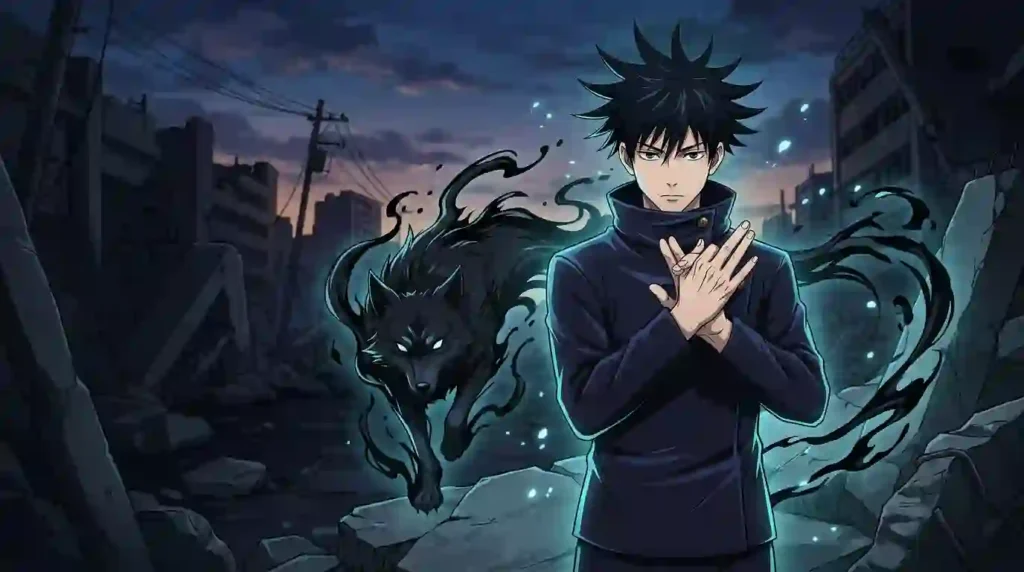
Trying to understand Megumi Fushiguro can feel frustrating when clips, fan theories, and manga spoilers tell different stories. A dramatic injury looks like a death, while Sukuna’s actions blur which powers belong to whom. By providing precise answers regarding his age, family, Ten Shadows Technique, domain growth, and conclusion, this guide helps you follow his journey without making any mistakes. theory for canon.
Spoiler warning: This guide includes major original-manga spoilers, including Tsumiki’s fate, Sukuna’s possession, and the ending. If you want only character basics, read the profile, age, and personality sections first.
Who Is Megumi Fushiguro in Jujutsu Kaisen?
At the beginning of the game, Megumi Fushiguro is a Grade 2 jujutsu sorcerer and a first-year student at Tokyo Jujutsu High. He fights curses with the Ten Shadows Technique, an inherited ability associated with the Zenin clan. He forms the main student trio with Yuji Itadori and Nobara Kugisaki.
His first mission brings him into Yuji’s life while he searches for a dangerous cursed object: one of Ryomen Sukuna’s fingers. That meeting sets the wider story in motion. It also reveals a key aspect of his personality: he makes tough choices based on who he thinks should be protected.
He is quiet, observant, and skilled at reading a fight. However, he is not simply the serious friend beside a cheerful hero. His family ties, tactical decisions, and vulnerability to Sukuna make him essential to the plot rather than a supporting character who only reacts.
What Are His Key Character Facts?
This table gives you a quick reference before the deeper explanations. The age entry refers to his introduction, while the survival entry refers specifically to the original manga’s ending.
| Detail | Canon information | Why it matters |
|---|---|---|
| Series | Jujutsu Kaisen, created by Gege Akutami | Establishes the character’s original story and creator |
| School | Tokyo Jujutsu High | Connects him to the main student cast and sorcerer training |
| School year | First year at introduction | Explains why he still has major skills to develop |
| Introductory age | 15 | Prevents confusion between his profile age and later story dates |
| Birthday | December 22 | Places his birthday shortly before the final December battle |
| Initial sorcerer rank | Grade 2 | Shows that he begins with recognized ability, not beginner status |
| Inherited technique | Ten Shadows Technique | Supplies his main summons and shadow-based tactics |
| Domain expansion | Chimera Shadow Garden | Reveals his progress beyond ordinary summoning |
| Father | Toji Fushiguro, born into the Zenin clan | Explains his bloodline and Gojo’s connection to his childhood |
| Sister | Tsumiki Fushiguro, his older stepsister | Provides a major personal reason for his choices |
| Teacher | Satoru Gojo | Challenges His tendency to view himself as disposable |
| Closest student allies | Yuji Itadori and Nobara Kugisaki | Anchor his school life and the final rescue effort |
| Japanese anime voice | Yuma Uchida | sets him apart from Megumi Ogata, a voice actor. |
| Original-manga ending | Alive and free from Sukuna’s possession | Answers the main death question without relying on fan theories |
How Old Is Megumi, and When Is His Birthday?
When Jujutsu Kaisen presents Megumi Fushiguro, he is fifteen years old and was born on December 22. The official character profile gives the introductory age; it should not be treated as an age that stays fixed throughout every event. The original manga’s final major battle takes place on December 24, after that birthday.
Following the story’s 2018 calendar, he would therefore be 16 by the final battle. That is a timeline calculation, not a different introductory profile. For a simple, accurate description, use “15 at introduction” and specify the story period when discussing his later age.
He also remains a first-year student despite facing threats far beyond ordinary school life. His ability can make him seem older, but his age helps explain the pressure he faces. Readers should not confuse combat responsibility with adult experience.
What Makes Megumi Fushiguro Decide Who to Save?
He does not begin with Yuji’s desire to give everyone a proper death. Instead, he wants good people to have a fair chance at life. Tsumiki’s kindness strongly shapes that belief, especially because the world does not reward her goodness with safety.
That outlook creates tension rather than a tidy moral rule. He recognizes that choosing whom to protect involves personal judgment. His decision to support Yuji shows that he can act on that judgment even when powerful authorities demand a different outcome.
His restraint also hides a dangerous habit: he can treat his own life as a tool for saving someone else. Gojo challenges that thinking because accepting death too quickly limits both his growth and his options. Learning to chase a victory rather than just a beneficial sacrifice is part of his maturation.
One helpful reading of his personality is that his silence does not mean he feels little. His actions reveal loyalty, fear, frustration, and care that he rarely explains aloud. Watching what he risks often tells you more than listening for a speech.
Who Are His Father, Mother, and Zenin Relatives?
Toji Fushiguro, who was born into the Zenin clan and subsequently adopted the Fushiguro surname, is his father. Toji lacks cursed energy but possesses extraordinary physical ability through Heavenly Restriction. His son follows a very different path: he inherits a prized cursed technique.
Megumi Fushiguro’s connection to the Zenin clan comes through Toji, not through Gojo. His biological mother dies during his early childhood, and the original story does not give her a widely used personal name. Because of their parents’ relationship, Tsumiki becomes his stepsister.
The Zenin family values inherited techniques and status, which makes Ten Shadows especially important to his future. That family interest does not mean he shares the clan’s priorities. His strongest commitments center on people, not the prestige attached to his bloodline.
Keep three relationships separate when discussing his family:
- Toji: His biological father.
- Tsumiki: His older stepsister, not his twin or biological sister.
- Gojo: His teacher and an important childhood supporter, not his biological father.
These distinctions explain why family charts can confuse new readers. Blood relatives, household relationships, and mentoring roles overlap in the plot, but they are not interchangeable.
Who Is Tsumiki, and What Happens to Her?
Tsumiki Fushiguro is his older stepsister and one of the most important people in his life. She cares for him during their difficult childhood and challenges his cynical view of others. Her example gives his wish to protect good people a personal foundation.
She spends much of the early story in a coma. When the Culling Game brings her into the conflict, rescuing her becomes a major goal. He approaches that goal through rules, points, alliances, and careful planning rather than treating it as a simple fight.
Major manga spoiler: The person acting through Tsumiki’s body is Yorozu, an incarnated sorcerer. Sukuna later kills Yorozu while she occupies that body, and Tsumiki dies as well. The manga depicts the fatal outcome in Chapter 219.
Her death matters beyond its shock value. Sukuna uses it to deepen her brother’s despair and weaken his resistance. The rescue goal that once gave him direction becomes a source of devastating loss, which helps explain his condition during the final battle.
How Does the Ten Shadows Technique Work?
Megumi Fushiguro uses shadows as a medium to summon shikigami, supernatural familiars with different abilities. Hand signs help shape those summons. The technique gives him a toolkit for tracking, attacking, distracting enemies, escaping, and controlling space.
The user begins with Divine Dogs and must defeat additional shikigami in subjugation rituals to gain normal control over them. Calling a creature into such a ritual does not prove that the user has tamed it. Outside help also prevents that ritual from counting as a successful solo subjugation.
He can use shadows for more than animal summons. He hides objects within them and uses shadow movement to complicate an opponent’s view of the battlefield. These options reward planning: a weapon, a distraction, and a hidden approach can work together.
In general, a destroyed shikigami cannot simply return in its original form. Certain surviving shikigami can inherit power through the technique’s rules, as Divine Dog: Totality demonstrates. That inheritance does not mean every destroyed summon freely combines with every other one.
The key distinction is access versus control versus mastery. Access lets a sorcerer attempt a summon, control allows regular use after subjugation, and mastery concerns how effectively that sorcerer fights with it. Confusing those stages leads to exaggerated claims about his strength.
Which Shikigami Belong to Ten Shadows?
The technique contains ten shikigami types, including summons that the manga demonstrates through Sukuna rather than through the student’s own battles. This table separates each creature’s role from common misunderstandings. It is not a claim that every summon remains available after the ending.
| Shikigami | Main role or demonstrated ability | Important limit or clarification |
|---|---|---|
| Divine Dogs | Track curses and attack at close range | The original pair counts as one shikigami type; Totality develops through inheritance |
| Nue | Provides aerial movement and electrical attacks | Its size and performance depend on the user’s application of the technique |
| Toad | Uses its tongue to restrain targets or help allies move | Utility and positioning matter more than raw attack power |
| Great Serpent | Ambushes and restrains an opponent with its large body | Sukuna destroys the early summon during the detention-center events |
| Max Elephant | provides significant physical mass and releases a lot of water. | It requires a lot of cursed energy to summon. |
| Rabbit Escape | Produces numerous rabbits that distract and conceal movement | Its main value is creating confusion, not winning a direct power contest |
| Round Deer | Produces positive energy through reverse cursed technique | Sukuna demonstrates its healing and technique-interference applications |
| Piercing Ox | Charges forward with force that increases over distance | Its straight-line movement creates a tactical limitation |
| Tiger Funeral | Appears by name in the components of the merged shikigami Agito | The original manga does not fully demonstrate it as a separate summon; avoid inventing a complete ability list |
| Mahoraga | Adapts to phenomena through exposure and its wheel mechanism | Summoning it without taming it puts the user in danger too |
The most useful summon depends on the problem. Rabbits can create an opening that a stronger attack cannot, while a toad can rescue someone without defeating the enemy. His fights make more sense when you watch the sequence of decisions, not just the biggest creature on screen.
What Is Megumi’s Domain Expansion?
Megumi Fushiguro’s domain expansion is Chimera Shadow Garden. It floods the surrounding space with shadows and expands what he can do with his technique. He first reveals it against a finger bearer in manga Chapter 58.
A domain expansion generally expresses a sorcerer’s technique within an enhanced space. Many completed domains establish a barrier and a sure-hit effect, but his remains incomplete in the original manga. He does not demonstrate the standard completed, enclosed domain with a guaranteed hit.
That limitation does not make it useless. He creates shadow-based doubles and employs the domain to launch surprise strikes. In opposition to Reggie Star, the building around him provides the cage that he is unable to completely establish on his own.
His use of the domain against Dagon shows another kind of value. By contesting the enemy’s domain, he disrupts its sure-hit advantage and helps create an escape route. The scene demonstrates useful barrier interaction without establishing that he can overpower any completed domain.
Two names are especially easy to confuse:
- Chimera Shadow Garden: His own domain expansion.
- Malevolent Shrine: Sukuna’s domain expansion.
Sukuna occupying his body does not turn Malevolent Shrine into the student’s original technique. Ownership of the body and ownership of an ability are different questions.
Why Is Megumi Summoning Mahoraga So Dangerous?
Mahoraga is the most dangerous untamed shikigami associated with Ten Shadows. Its ability to adapt enables it to form reactions to the things it comes across. However, adaptation requires a process; it does not mean Mahoraga automatically ignores every possible attack from the first moment.
During the Shibuya Incident, he summons Mahoraga in a subjugation ritual after suffering severe injuries. He draws Haruta Shigemo into that ritual despite lacking control over the shikigami. Mahoraga attacks him as well, leaving him in a suspended state within the ritual rather than establishing a straightforward permanent death.
Sukuna intervenes and defeats Mahoraga. Because an outsider resolves that battle, the encounter does not grant the original summoner a successful solo taming. The ritual explanation around Chapters 117–119 makes the distinction.
For a beginner, the simplest comparison is opening a cage you cannot control. Releasing the threat changes the fight, but it does not make the threat your ally. That explains why calling Mahoraga can function as a last resort rather than a normal finishing move.
The scene also connects his powers to his personality. He reaches for an option that can destroy him along with his opponent. Gojo’s earlier criticism of self-sacrifice helps readers understand why that decision represents both determination and danger.
How Does Gojo Shape His Growth?
Gojo becomes involved in his life when he is still a child. Toji had made arrangements for him to be taken by the Zenin clan under terms related to his inherited skill. Gojo intervenes in that future and later teaches him at Tokyo Jujutsu High.
Their most important lessons concern mindset as much as technique. Gojo pushes him to stop treating a mutual loss as equivalent to winning. A sorcerer who assumes death is the strongest available option may overlook a risky but survivable path.
That advice becomes visible when he first expands his domain. Instead of immediately choosing his most destructive last resort, he tests his own imagination and ability. The result is incomplete, but it represents a major step toward fighting for his own survival.
Gojo also explains a historical clash involving a Six Eyes and Limitless user and a Ten Shadows user. That history establishes the technique’s importance. It does not prove that its current teenage user already matches Gojo or has achieved the same level of mastery.
Why Are Yuji and Megumi Such Important Friends?
Yuji and Megumi repeatedly protect each other when institutional rules and personal guilt threaten to separate them. Their friendship begins with a dangerous decision, not a comfortable school introduction. Each becomes someone the other refuses to treat as disposable.
They also approach morality differently. Yuji wants to help people broadly, while his friend starts from a more selective idea of whom he wants to save. Their conversations reveal those differences without making either person a simple answer to every moral problem.
Nobara matters to this relationship too. The main trio’s ordinary arguments, shared missions, and moments of humor give the story a life outside its disasters. Those scenes explain what they stand to lose when the larger conflict tears them apart.
The final rescue effort gains weight from that shared history. Yuji’s determination does not rest only on defeating a villain. He wants his friend back, and the ending restores the trio’s ability to work together rather than leaving their bond as a memory.
Why Does Sukuna Take Over Megumi’s Body?
Sukuna takes over Megumi Fushiguro’s body in Chapter 212, using the binding vow he previously made with Yuji. He activates his temporary control, transfers himself into a finger, and forces the new vessel to swallow it. The takeover is hostile, not a voluntary partnership.
Ten Shadows helps explain Sukuna’s interest, but timing also matters. He waits for an opening in the younger sorcerer’s emotional defenses. The revelation involving Tsumiki provides a moment when his ability to resist is vulnerable.
The phrase “Sukuna in Megumi body” describes this possession storyline, not a separate character with a separate childhood. Fans also use the nickname “Meguna” for this appearance. That nickname is useful shorthand, but it is not his formal character name.
After the takeover, Sukuna uses the inherited technique with his own skill and cursed energy. The scale of those attacks should not be credited automatically to the original owner. Seeing the same technique does not mean seeing the same level of control.
The younger sorcerer initially interferes with Sukuna’s output when Sukuna attacks his allies. Sukuna then uses the bath ritual and the killing of Tsumiki to suppress that resistance further. These events frame the possession as the destruction of agency, not a mutually beneficial team-up.
Does Megumi Die in JJK, or Does He Survive?
Megumi Fushiguro survives the original Jujutsu Kaisen manga. Sukuna’s possession places him in extreme danger, but it does not erase his existence or establish his permanent death. Chapter 268 shows the outcome of his separation from Sukuna.
This is why the question “How did Megumi die?” starts from the wrong premise when it refers to the original ending. He suffers injuries, possession, and overwhelming loss. None of those events changes the fact that he returns alive.
Yuji reaches him during the final battle, and he begins resisting again in Chapter 266. The rescue depends on a wider effort, including the pressure on Sukuna and Nobara’s intervention. It would be inaccurate to describe the outcome as a single effortless rescue move.
The final chapter shows him carrying out a mission with Yuji and Nobara. That scene provides stronger evidence than an ominous panel or a theory posted before the ending. Survival does not erase his grief, but the story allows him to continue living and acting with his friends.
Which Manga Chapters Explain His Biggest Turning Points?
The story of Megumi Fushiguro becomes easier to follow when you separate power development, possession, and recovery. These chapter references give you a reading path through the original manga. They also help you check whether a claim concerns something he does himself or something Sukuna does while possessing him.
| Chapter or range | Turning point | What to watch for |
|---|---|---|
| Chapter 1 | First meeting with Yuji | His mission and his early choice about protecting another person |
| Chapter 58 | First use of Chimera Shadow Garden | A shift from accepting sacrifice toward attempting a personal breakthrough |
| Chapters 117–119 | Mahoraga ritual in Shibuya | The difference between summoning, surviving, and successfully taming |
| Chapters 171–173 | Battle with Reggie Star | Environmental planning and the practical limits of an incomplete domain |
| Chapters 211–212 | Tsumiki revelation and Sukuna’s takeover | The emotional opening that enables the possession |
| Chapters 216–219 | Suppression of resistance and Tsumiki’s death | Sukuna’s deliberate attack on his will to fight |
| Chapter 266 | Renewed resistance | His contribution to the final struggle rather than simple passive rescue |
| Chapter 268 | Separation from Sukuna | Direct evidence for his survival |
| Chapter 271 | Mission with the reunited trio | The original story’s confirmation that his life continues |
How Strong Is He Without Sukuna?
His introductory Grade 2 rank gives a clear starting point, not a complete measurement of every later battle. He grows through better domain use, more inventive shadow tactics, and sharper planning. His fight with Reggie offers a strong example of victory through information and positioning.
He is especially effective when different abilities solve different parts of a problem. A distraction can conceal movement, water can change the terrain, and a hidden weapon can force an opponent to react. His strength comes from combining those choices, not relying on a single summon every time.
Three claims need careful limits:
- “He controls Mahoraga in Shibuya.” He summons it in a ritual; he does not successfully tame it there.
- “His domain is complete.” The original manga does not show him achieving a completed version.
- “Everything Sukuna does proves his own power.” Sukuna’s performance uses Sukuna’s experience and resources.
The ending also does not provide a complete inventory of every shikigami he can still summon. Avoid turning an unanswered detail into a confident claim about his future arsenal. The final mission confirms his return to sorcerer work, not a fully documented new power level.
What Makes His Character Arc Meaningful?
Megumi Fushiguro’s arc connects the desire to protect others with the difficulty of accepting help. Early in the story, he acts as though his own life can become the price of another person’s safety. Later, his friends insist that his life also deserves protection.
One interpretation of the ending is that it answers his early moral judgment with a personal bond. He once chose to support Yuji despite the danger surrounding him. Yuji later refuses to abandon him even when rescuing him makes the final conflict harder.
His recovery should not be mistaken for proof that grief disappears through determination. He receives encouragement, a chance to rebel, and a post-loss future from the manga. Tsumiki is not restored, nor is the ownership rendered innocuous.
That combination makes his ending more meaningful than a simple survival score. He returns to a life that remains difficult, but he no longer faces it entirely alone. His friends’ presence gives the final mission an emotional purpose alongside its practical one.
Does Megumi Ogata Voice This Character?
No. Yuma Uchida voices him in the Japanese anime. Megumi Ogata voices Yuta Okkotsu, a different student in Jujutsu Kaisen, as the official anime character credits show.
The shared given name causes search confusion, but it does not indicate a character relationship. The Ten Shadows user and Yuta have distinct roles, backgrounds, and skill sets. When checking a voice credit, match the actor to the full character name rather than to one shared word.
How Can a Megumi PFP Be Selected Without Giving Any Clues?
A Megumi PFP is a character’s profile photo. Even in a little photo, his high-collared clothing and dark, spiked hair make him identifiable. A clear face crop usually reads better than a crowded battle panel.
If you want to avoid spoilers, choose an early-story appearance. While late-manga panels can indicate significant consequences, images displaying Sukuna’s facial markings betray the possession plot. A visually striking picture is not automatically a safe choice for anime-only friends.
Use this practical checklist before uploading:
- Choose artwork you created, have permission to use, or can use under its stated license.
- Before utilizing fan art, read the creator’s guidelines.
- Keep the face inside the area a circular avatar will display.
- Test the image at a small size, not only at full resolution.
- Do not remove an artist’s signature or watermark.
- Remember that giving credit does not replace permission.
Official artwork is also copyrighted, so “official” does not automatically mean unrestricted use. Check the permission terms rather than assuming every promotional image is free to reuse. This guide provides selection advice, not downloadable artwork or legal clearance.
Is Sukuna x Megumi a Canon Relationship?
“Sukuna x Megumi” is a fan-shipping label, not a canon romance. The original manga depicts coercion, possession, and psychological harm between them. It does not establish a consensual romantic relationship.
Fan interpretations can explore ideas outside the source material, but character guides should label them clearly. What the manga affirms is unaffected by an edit, illustration, or fan narrative. Keeping those categories separate helps new readers understand the plot without confusing fandom language with official events.
How Can You Read His Story Without Confusing Theories with Canon?
Start by identifying which version of the story a discussion covers. An anime scene, an original-manga chapter, and a fan prediction may refer to different points in the plot. A claim that sounded plausible before the ending can become false once later chapters resolve it.
Then check the action itself. Ask who controls the body, which technique they use, and whether the manga actually confirms the outcome. Those three questions prevent many mistakes about his summons, domain, and survival.
A useful reading order is:
- Learn the early profile and family relationships.
- Understand the basic rules of Ten Shadows.
- Read the first domain reveal before judging its later limits.
- Separate the Shibuya ritual from later uses of Mahoraga.
- Follow the possession chapters before interpreting the final rescue.
- Before making a death claim again, make sure you check the conclusion.
With this method, you can enjoy analysis without considering every interpretation to be true. It also makes rereading rewarding because small tactical decisions become easier to recognize. His story gains depth when the rules and the relationships stay connected.
Frequently Asked Questions
1. Does Megumi Fushiguro die in the original manga?
No. Megumi Fushiguro survives, separates from Sukuna in Chapter 268, and joins Yuji and Nobara on a mission in Chapter 271. His confirmed original-manga ending is survival, not permanent possession or death.
2. At the beginning of Jujutsu Kaisen, how old is Megumi?
He is 15 at his introduction, with a birthday on December 22. Following the manga’s calendar, he would be 16 by the December 24 final battle.
3. Who is Megumi’s sister?
His sister is Tsumiki Fushiguro, his older stepsister. Her kindness shapes his values, and her fate becomes central to the Culling Game and possession storyline.
4. What is Megumi’s domain expansion called?
His domain expansion is Chimera Shadow Garden. It expands his shadow-based technique, but the original manga never shows him completing the standard enclosed domain with a sure-hit effect.
5. Why does Sukuna want Megumi’s body?
Sukuna is aware of Ten Shadows’ worth and the potential for using him as a conduit. He exploits an emotional opening to carry out the takeover; the possession is not voluntary.
6. Did Megumi die after summoning Mahoraga?
The Shibuya ritual does not establish his permanent death. Mahoraga leaves him suspended within the ritual, and Sukuna intervenes, defeats the shikigami, and keeps him alive.
His Story Is About More Than Surviving
Megumi Fushiguro matters because his choices connect family, friendship, inherited power, and personal loss. It takes more than just memorizing the summons or inquiring as to whether he dies to comprehend him. The central question is how someone who keeps risking himself for others learns to accept a future of his own.
On your next reread, compare his first domain expansion, the Mahoraga ritual, and his renewed resistance in Chapter 266. Notice when he seeks a win and when he treats himself as expendable. Those moments reveal the change beneath the action.
Which scene best shows that growth: his first domain, his battle with Reggie, or his return to fighting beside his friends? Share your choice and explain it with a chapter or scene. A specific observation adds more to the discussion than another unsupported death theory.