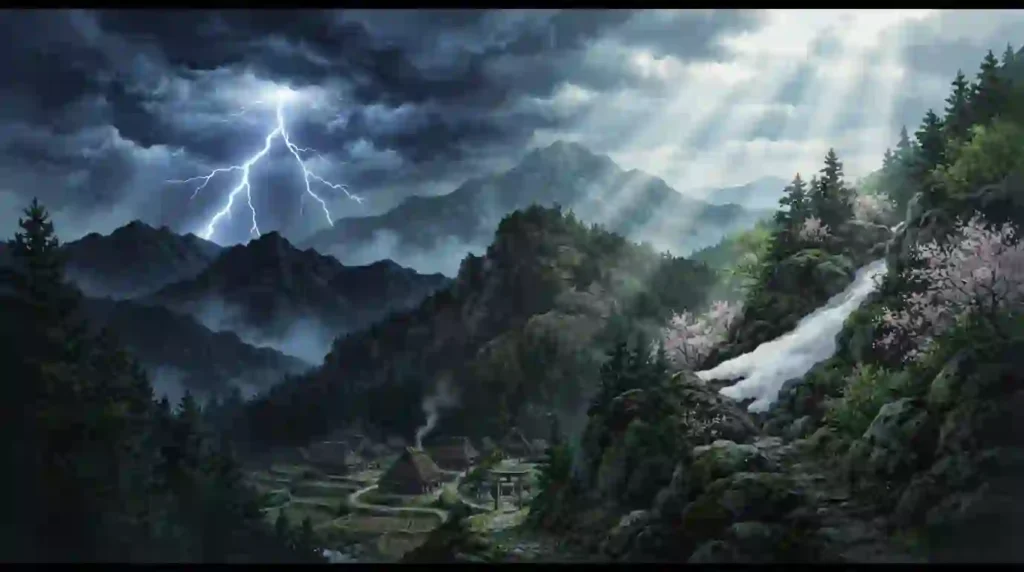
Short Answer: What Is This Oneshot?
Raimei to Zansetsu (雷鳴と残雪) is a complete 2023 Japanese oneshot romance doujinshi by Jinmen Shijimi (人面シジミ), released digitally through DLsite. The English edition is officially titled “Thunder and Snow.” It tells the story of Shao, a thunder-bearing supernatural leopard who hates humans, and Yukino, a blind woman whose strange powers humble him again and again. It is an 18+ work with explicit adult content, so read the advisory section below before you buy.
Finding clear, honest information about the title is harder than it should be. Search results are a maze of scattered forum posts, bare database entries and unofficial scan files that tell you nothing about the actual story. This guide fixes that problem. Inside, you get the title meaning, a full (non-explicit) story breakdown, character and theme analysis, content warnings, and exactly where to read it legally.
The Oneshot at a Glance
Here is everything we verified about Raimei to Zansetsu in one place.
| Detail | Information |
|---|---|
| Title (Romaji) | Raimei to Zansetsu |
| Original Title (Japanese) | 雷鳴と残雪 -Thunder and snow- |
| English Title | Thunder and Snow |
| Other Official Titles | Donner und Schnee, Tonnerre et neige, Tormenta y nieve, 雷鸣与残雪, 번개와 눈 |
| Creator | Jinmen Shijimi (人面シジミ) |
| Circle | Negi Manju (ネギ饅頭) |
| Year Released | 2023 |
| Format | Original digital doujinshi, oneshot (complete) |
| Length | Approximately 100 pages |
| Original Publisher | DLsite (Garumani Senbai edition) |
| Distribution | Digital download only; no official print release reported |
| Official Translations | English, Simplified Chinese, Korean (via DLSITE) |
| Setting | Historical Japan, rural village landscape |
| Main Characters | Shao (supernatural leopard), Yukino (blind human woman) |
| Genres | Adult, Romance, Supernatural, Historical, Fantasy |
| Status | Oneshot; story complete |
| Age Rating | Adults only (18+), explicit content |
| Community Rating | 8.3 / 10 average (23 votes) on MangaUpdates; Bayesian average 7.15 |
| Official Product Code | RJ01070319 (Japanese edition) |
What Does the Title Mean? A Full Breakdown
The name translates literally as “thunder and the snow that remains.” Both halves of the title do narrative work, and neither is decoration.
Raimei (雷鳴) means a rolling thunderclap or the sound of thunder itself. Japanese storytelling often binds thunder to beings who arrive violently and without warning, like lightning-wielding yokai or storm gods. That is precisely how Shao enters the story: he does not walk into a village, he arrives with the storm.
Zansetsu (残雪) means “remaining snow,” the patch that refuses to melt in a shaded corner long after spring has started. The official blurb leans on this exact image. The creator’s own framing compares the heroine to snow that sits unmelted in the shade even after spring arrives, and that comparison is the emotional core of the whole work.
Put the two halves together and the title becomes a thesis: the storm that destroys and the stillness that endures. One is loud, moving and feared. The other is quiet, persistent and easy to overlook. The story asks what happens when the storm stops trying to dominate and simply falls in love with the quiet.
The heroine’s name is no accident either. Yukino (雪乃) literally contains the character for snow, folding her into the imagery from the first page. The full Japanese title therefore reads less like a pretty label and more like “the storm and the thing it cannot melt.”
Story Summary (Spoilers Ahead)
The oneshot opens in the classical monster-story register. Shao is a mononoke, a Japanese supernatural being, shaped like a great leopard. He appears alongside thunderclaps and raids human villages as a matter of habit and appetite. Humans are food and prey to him, nothing more.
One of those raids goes wrong. He meets Yukino, a human woman who is blind and who carries an unusual power of her own. She repels his assault with embarrassing ease. No bluff, no dramatic reversal, just a quiet woman who cannot see him and beats him anyway.
Defeat does not teach Shao respect immediately. It teaches him obsession. He returns again and again, determined to win the match, and loses every single time. The repetition is comic at first, then worrying, then something else entirely: a fixation that slowly curdles into longing.
The turning point comes when the two of them become lost together, outside the village, away from the roles they play. Away from raid and resistance, Shao sees Yukino as a person rather than a target. He falls in love with her.
Then the story delivers its real wound. Yukino is married. Her husband exists, her life exists, and Shao’s love arrives too late and in the wrong shape to fit inside them. He is heartbroken, and the work does not pretend heartbreak is noble or clean.
What follows is a story about desire running into the walls of ordinary life, told in the explicit register typical of its genre. The narrative resolves as a tragic, sincere romance rather than a tidy fantasy: a monster who wants what he cannot simply take, and a woman who sees the world by sound and touch and still, impossibly, seems to see him.
If you want erotica with a plot, this is not that. The explicit content is the vehicle. The engine is longing, pride and defeat.
The Main Characters
Two figures define Raimei to Zansetsu, and everything else in the story orbits them.
Shao, the thunder-leopard who hates humans
Shao is written as appetite in motion. He is violent by habit, proud by nature and lonely without realizing it. His repeated losses to Yukino break something open in him, and the story tracks how humiliation becomes devotion. He is not softened into a hero; he is simply forced to discover that power and love obey different rules.
Yukino, the blind woman with a quiet power
Yukino is the character the title is secretly about, the unmelted snow in the shade. Blindness is not played as weakness or as a gimmick. It defines how she meets the world: through sound, air, temperature and instinct. Her strength lets her beat a monster head on, yet her ordinary human life, including a marriage, remains something Shao cannot defeat.
The husband
Yukino’s spouse never needs page space to matter. He is the living proof that her heart is already spoken for, and his existence converts Shao’s romance into something closer to grief. You feel his weight without needing a single sympathetic scene from him.
The villagers
They exist as the backdrop that explains both characters. To Shao they are prey. To Yukino they are community, vulnerability and obligation. The village is the arena where monster and human fail to meet until the story carries them somewhere lost, literally and emotionally.
Themes and Symbolism
Raimei to Zansetsu rewards readers who look past the surface. The themes do most of the heavy lifting.
The storm and the shade-snow: Shao is sound, force and noise. Yukino is silence, persistence and temperature. The title stages the entire relationship as weather, and the story pays that metaphor off scene by scene.
Perception versus sight: Yukino cannot see Shao, and Shao, for all his senses, cannot read her at first. Both characters are blind in their own way, and the romance progresses as each learns to perceive what the other actually is.
The outsider in human society: Shao is the ultimate outsider, a creature who views humanity from above and outside. Falling for Yukino is not just falling for a person; it is a collapse of the worldview that kept him safe.
Unrequited timing and the ethics of wanting: the work does not flinch from its central cruelty. Wanting Yukino is easy for Shao. Having her, without becoming the thing that destroyed her village, is the impossible part. Desire is pushed hard against consent, marriage and consequence.
Sacrifice and cost: community listings tag the release with sacrifice-related themes, and that word points at the real bill of the romance. Love here is not weightless. It costs pride, safety and peace, and the work asks who pays for whom.
Mono no aware, the ache of impermanence: the lingering-snow image echoes classical Japanese aesthetics, beauty tinged by awareness that it will eventually melt or vanish. That ache is applied directly to desire: nothing here is permanent, and permanence is exactly what both characters hunger for.
Art Style and the Creator Behind It
Jinmen Shijimi, writing and drawing under the circle name Negi Manju (ネギ饅頭), builds the work around contrast. Shao is drawn with overwhelming physical presence: mass, fangs, claws, storm-dark composition. Yukino is drawn with stillness, soft lines and quiet negative space. The page literally breathes differently depending on whose perspective dominates.
The historical rural setting gives the supernatural elements room to feel earned. When a village fears the sky going dark, the art sells it. When the mood shifts to two people lost together in nowhere, the detail thins and the silence thickens, which is exactly what the story needs at its hinge point.
This is a oneshot, not a serialized epic, and the art respects the constraint. Every page either escalates the conflict or strips it down. There is no filler, which suits the roughly 100-page format.
The release was distributed originally as a digital doujinshi through DLsite in Japan, including a Garumani Senbai edition, and official editions also exist in English, Simplified Chinese and Korean through DLSITE. As of November 2026, there is no official print release, and MangaUpdates lists 23 user votes with an 8.3 average rating, which tells you the audience is small, deliberate and engaged rather than casual.
Content Advisory and Age Rating (Read This First)
Raimei to Zansetsu is an adults-only work. It contains explicit sexual content and sits squarely inside the hentai and dark romance tags on every major doujinshi database. Do not buy, open or share it around anyone under 18.
The advisory list below comes straight from community tagging on MangaUpdates and retailer genre labels, and you should treat it seriously.
The categories listed include beast-type characters (a leopard kemono mononoke), an interspecies relationship, a blind female lead, mature sexual content and explicit scenes.
More serious warnings tagged by the community include dubious-consent and sexual-violence-adjacent themes, alongside sacrifice-related plot elements. Readers who are sensitive to sexual violence, coercive dynamics or gore-adjacent darkness should skip this title entirely.
The heroine is an adult married woman. The protagonist is an adult non-human being. There is no ambiguity about the ages involved, but there is real ambiguity, honestly flagged, around the ethics of what happens.
This is not a cute, safe or wholesome romance. It is a dark, explicit, tragic supernatural romance for adult readers who specifically want that. If any of the above gives you pause, listen to that pause and choose another title. A good reader guide protects you before it persuades you.
Where to Read It Legally
Raimei to Zansetsu is a DLsite exclusive in Japan, released as a digital download with no print edition reported. Official English, Simplified Chinese and Korean translations are distributed through DLSITE, the international arm of the same platform. In practice, that means there is one legitimate source, and it happens to be the creator’s own storefront channel.
Here is what that means for you practically.
The original Japanese edition is listed under product code RJ01070319, and the official English edition sits under its DLSITE counterpart. You can search those codes directly on either storefront.
The release is digital-only. You will not find a tankobon in a bookstore, and you should be skeptical of any physical copy offered for sale.
Retailer coverage notes a free preview of roughly 10 pages, which lets you check the art style and content tags before paying.
DLsite runs frequent discount campaigns, and this title has appeared in sale events, so you rarely need to pay full list price.
Buying officially is the most effective way to support Jinmen Shijimi and the Garumani Senbai release channel. Pirated scan files siphon revenue directly from doujinshi creators, who usually self-fund printing, translation and event costs.
Avoid any site offering a free download of the archive. Beyond the legal and ethical problems, pirate files are the most common vector for malware disguised as manga archives, and they frequently carry broken translations that mangle the one thing worth reading closely: the creator’s dialogue.
Is It Worth Reading? An Honest Verdict
Raimei to Zansetsu is worth reading for exactly one audience: adults who want a dark, tragic, supernatural romance where the monster is the protagonist and love is a consequence, not a reward. For everyone else, it will bounce hard off its first explicit page.
Strengths:
The premise is instantly legible. Storm-monster, quiet human, impossible outcome. You understand the whole book from one sentence, and then it spends 100 pages complicating that sentence.
The symbolism is disciplined. Thunder, shade-snow, blindness and marriage each carry the story’s weight rather than decorating it.
It is complete. No cliffhangers, no 12-volume commitment, no filler arcs. One sitting, one arc, one ending.
The blind heroine is written as a person with a life and a marriage, not as a plot device, which raises the emotional stakes above typical genre fare.
Weaknesses:
The explicit register will exclude readers who would otherwise enjoy the romance and the art.
The tagged dark themes, including dubious consent, are genuinely difficult and not for everyone.
Availability is narrow: one platform, one language pipeline, no print.
The 8.3 community average with only 23 votes is solid but thin; treat it as a strong niche signal, not a mass-market verdict.
Verdict: if the advisory section did not scare you off and you arrived here searching for meaning, plot context and a legal way in, this release will give you a compact, memorable and bittersweet read rather than a guilty blur.
How It Compares to Similar Works
Raimei to Zansetsu sits at the intersection of three doujinshi traditions: supernatural mononoke romance, kemono-beast artwork and tragic adult romance. Comparisons help you locate it fast.
Versus monster-romance light novels: the oneshot format wins on density. No 300-page simmer; the arc lands in a single sitting.
Versus kemono art collections: it is a full story with a recurring cast and a climax, not a character art dump.
Versus mainstream dark romance manga: it is shorter, rawer and more symbolic, trading volume for intensity.
Versus typical DLsite adult romance: the tragic structure and the shaded-snow motif push it above genre wallpaper. The explicit content is expected here; the writing ambition is the surprise.
Versus series with sequels: complete means complete. What you see is the whole statement, which suits readers who want closure rather than a commitment.
If this guide sparks your curiosity, the discovery path runs through the same platform: Garumani Senbai releases and Jinmen Shijimi’s author page on DLsite are where the creator actually lives. That is the correct next stop, never a scan aggregator.
Reader Reception and Search Interest
Raimei to Zansetsu is a niche title with a loyal, adult audience. MangaUpdates shows an 8.3 average from 23 votes, with roughly 56 percent of voters scoring it 9 or 10. Bayesian adjustment lands at 7.15, which is honest math for small-sample fanbases: enthusiastic, not universal.
Search interest clusters around five questions: what the title means, who made it, where to read it legally, what the content tags involve, and whether an anime exists. This guide answers all five, which is why it is structured the way it is.
There is no anime, live-action adaptation or game as of November 2026, and no sequel has been announced. Anyone claiming otherwise is speculating. For now, Raimei to Zansetsu exists only as the original digital release, and that is the complete and only official version.
Raimei to Zansetsu FAQs
What does the title mean in English?
It means “Thunder and Snow.” The Japanese original 雷鳴と残雪 pairs thunderclap (raimei) with snow that lingers unmelted after spring (zansetsu), a deliberate metaphor for the storm-monster protagonist and the heroine he cannot conquer.
Who created Raimei to Zansetsu?
Jinmen Shijimi (人面シジミ) created it under the circle name Negi Manju (ネギ饅頭). It released in 2023 as an original 100-page oneshot doujinshi published through DLsite’s Garumani Senbai channel.
Where can it be read legally?
Only through DLsite in Japan and DLSITE internationally, including official English, Simplified Chinese and Korean editions. It is digital-only, with no print release, and around 10 pages are free to preview before purchase.
Is it safe for minors?
No. It is an 18+ explicit adult work. Community tags include sexual-violence-adjacent and dubious-consent themes, so sensitive readers and every minor should avoid it.
Is it finished or ongoing?
It is a complete oneshot. The story has a definitive ending and no sequel has been announced as of November 2026.
Is there an anime or adaptation?
No. No anime, live-action adaptation or game exists or has been announced. The digital doujinshi is the only official version, and adaptation claims you find online are rumors.
Your Next Step
You now know what Raimei to Zansetsu is, what its title means, who made it, what it contains and where to read it without breaking the law or the creator’s trust. If it sounds like it is for you, head to DLsite or DLSITE, use the free preview, buy the official edition and judge it on your own terms.
If someone you know is searching for it too, send them this guide instead of a pirated file. Share it, bookmark it, and come back after reading to compare your reading of the storm and the snow with ours. The best conversations about it happen after the last page, and you are now ready to have one.