Tokyo Ghoul Manga vs Anime Differences: The Complete Breakdown Every Fan Needs
Written & Researched by ✍️ Mariam
Anime & Manga Content Specialist at Gojo.Blog
You watched Tokyo Ghoul and felt something was deeply missing from the story. Critical scenes felt rushed, beloved characters disappeared without any real explanation, and that final ending left you completely confused and frustrated. This complete guide breaks down every major Tokyo Ghoul manga vs anime differences so you finally understand the full story Sui Ishida originally created.
📑 Table of Contents
- What Are the Biggest Tokyo Ghoul Manga vs Anime Differences?
- How Does Tokyo Ghoul Season 1 Change the Original Manga Story?
- Why Did Tokyo Ghoul √A Deviate So Heavily from the Manga?
- What Happened to Kaneki’s Character Arc in the Anime?
- How Does the Aogiri Tree Arc Differ?
- Which Characters Got Cut or Changed?
- How Does Tokyo Ghoul:re Compare to Its Manga Source?
- What Are the Key Fight Scene Differences?
- Why Is the Tokyo Ghoul Anime Ending So Different?
- How Do Kagune Battles Change from Page to Screen?
- Should You Read the Manga After Watching the Anime?
What Are the Biggest Tokyo Ghoul Manga vs Anime Differences?
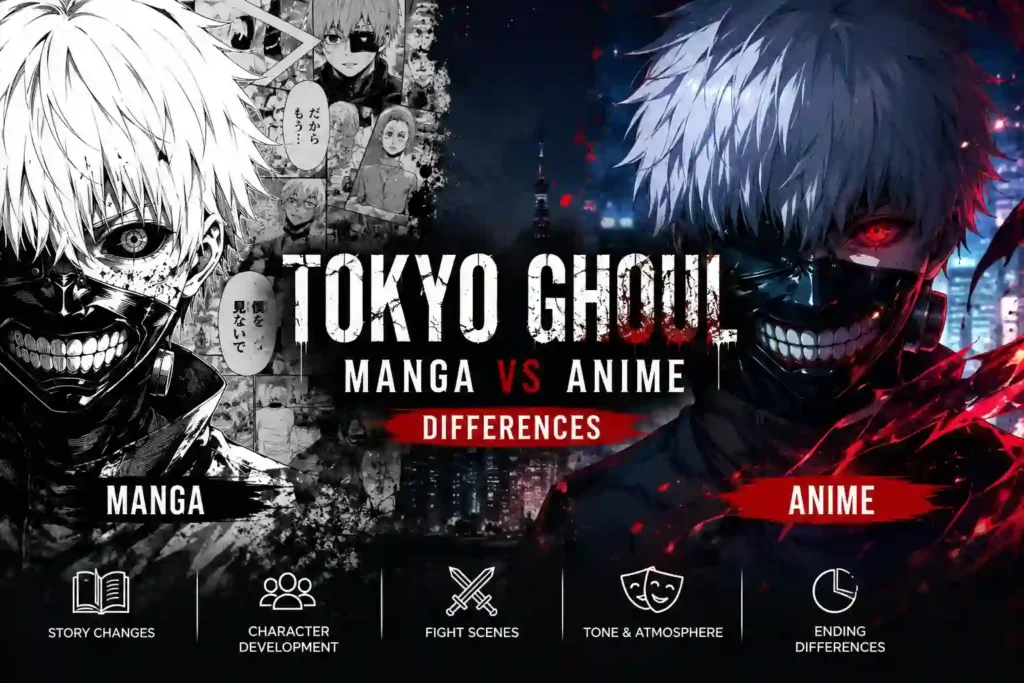
The Tokyo Ghoul manga vs anime differences start from the very first season and only grow wider as the series continues. Sui Ishida published the original manga in Shueisha’s Weekly Young Jump from 2011 to 2014, crafting a slow-burn psychological horror story. Studio Pierrot adapted it into a 12-episode anime in 2014, and the compression immediately created problems.
Entire character backstories vanished. Internal monologues that defined Kaneki Ken’s transformation got replaced with brief visual montages. The Tokyo Ghoul manga vs anime differences in pacing alone make the two versions feel like separate stories.
The manga gives you 143 chapters of original Tokyo Ghoul plus 179 chapters of Tokyo Ghoul:re to explore. The anime condenses everything into four short seasons of 12 episodes each. That math tells you exactly why so much content disappeared. If you enjoy deep-dive comparisons of anime and manga, you might also appreciate our guide to the best anime like Jujutsu Kaisen.
How Does Tokyo Ghoul Season 1 Change the Original Manga Story?
Season 1 covers roughly the first 66 chapters of the manga, and this is where the Tokyo Ghoul manga vs anime differences begin to surface. The anime follows the broad strokes of Kaneki’s transformation from human to half-ghoul after his encounter with Rize Kamishiro.
However, the manga spends significantly more time inside Kaneki’s mind. You read his fear, his hunger, and his desperate clinging to humanity across dozens of pages. The anime reduces this internal struggle to a few dramatic scenes and a striking visual style.
Anteiku’s role also shifts between the two versions. In the manga, the coffee shop serves as a genuine community hub where ghouls build real relationships. The anime rushes through these quieter moments to reach the action sequences faster.
Hideyoshi Nagachika’s friendship with Kaneki carries far more emotional weight in the manga. Their conversations reveal layers of loyalty and fear that the anime barely touches. These Tokyo Ghoul manga vs anime differences matter because they shape how you experience the story’s emotional core.
Why Did Tokyo Ghoul √A Deviate So Heavily from the Manga?
This is where the Tokyo Ghoul manga vs anime differences become impossible to ignore. Tokyo Ghoul √A (Root A) aired in 2015 and shocked fans by abandoning the manga’s storyline almost entirely. Sui Ishida reportedly contributed an original story outline for this season, but the result still confused longtime readers.
In the manga, Kaneki joins the Aogiri Tree organization after his torture by Jason (Yamori). He infiltrates them to grow stronger and protect his friends from the shadows. This decision drives the entire second arc of the manga and sets up critical events in Tokyo Ghoul:re.
The anime takes a completely different path. Kaneki forms his own small group and stays closer to Anteiku. This change ripples through every subsequent season and creates massive continuity problems when Tokyo Ghoul:re tries to reconnect with the manga’s plot.
The Aogiri Tree raid on the 11th Ward plays out differently in each version. The manga delivers a sprawling, multi-chapter battle with shifting alliances and genuine stakes. The anime compresses this into a handful of episodes that sacrifice tactical depth for visual spectacle.
What Happened to Kaneki’s Character Arc in the Anime?
Kaneki Ken stands at the center of every Tokyo Ghoul manga vs anime differences discussion, and for good reason. His transformation from a shy literature student into the One-Eyed King represents one of the most compelling character arcs in modern manga. For fans who appreciate complex character writing, our Satoru Gojo complete guide explores similar depth.
The manga shows Kaneki’s psychological deterioration in brutal detail. After Jason’s torture, Kaneki’s hair turns white and his personality fractures. You watch him adopt multiple personas — the ruthless “Centipede” Kaneki, the cold Haise Sasaki, and eventually the integrated king. Each shift earns its place through chapters of buildup.
The anime accelerates these changes dramatically. Kaneki’s white hair moment hits hard visually, but the psychological groundwork feels thin. By Tokyo Ghoul:re, the anime expects you to accept Haise Sasaki’s existence without the manga’s careful explanation of how CCG’s Quinx squad operates.
This compression robs Kaneki of his complexity. The manga lets you sit with his pain, his guilt, and his gradual acceptance of both his human and ghoul sides. The anime asks you to accept these shifts in a fraction of the time.
How Does the Aogiri Tree Arc Differ Between Manga and Anime?
The Aogiri Tree organization drives much of the conflict in both versions, but the Tokyo Ghoul manga vs anime differences in how this group operates are substantial. In the manga, Aogiri Tree functions as a militant ghoul liberation front with clear hierarchy and political goals.
Tatara, Eto (the One-Eyed Owl), and Noroi each receive detailed backstory chapters in the manga. You understand their motivations and their connections to the broader ghoul society. The anime reduces most of these characters to menacing silhouettes with cool kagune attacks.
The manga also explores the CCG’s internal politics alongside Aogiri Tree’s operations. Investigators like Kishou Arima and Koutarou Amon receive substantial development that the anime truncates. This dual perspective makes the manga’s conflict feel morally complex rather than simply good versus evil.
Which Characters Got Cut or Changed in the Anime Adaptation?
Character cuts represent some of the most painful Tokyo Ghoul manga vs anime differences for dedicated fans. Several manga characters either disappear entirely or receive drastically reduced roles in the anime.
- Shu Tsukiyama (The Gourmet): The manga gives Tsukiyama a rich arc exploring his obsession with Kaneki and his complicated loyalty. The anime keeps his flamboyant personality but strips away his deeper emotional layers.
- Uta and Itori: These Clowns faction members play crucial roles in the manga’s mystery elements. The anime barely acknowledges their existence until Tokyo Ghoul:re.
- Donato Porpora: A terrifying ghoul imprisoned in Cochlea who becomes vital in the manga’s later arcs. The anime sidelines him almost completely.
- Roma Hoito: Her true identity and connection to the Clown organization carry major manga spoilers that the anime never addresses properly.
- Kichimura Washuu: The manga’s central antagonist receives a methodical buildup across dozens of chapters. The anime rushes his reveal and reduces his threat level.
These cuts weaken the story’s interconnected web of relationships. The manga builds a living, breathing Tokyo where every character connects to the larger conflict. The anime narrows its focus to a smaller cast, which simplifies the narrative but sacrifices depth. If character depth matters to you, check out our complete guide to Vegeta’s character arc for another deep-dive comparison.
How Does Tokyo Ghoul:re Compare to Its Manga Source?
Tokyo Ghoul:re represents the most ambitious section of the story, and the Tokyo Ghoul manga vs anime differences here reach their peak. The manga’s :re arc spans 179 chapters and introduces an entirely new protagonist in Haise Sasaki before gradually merging his identity with Kaneki’s.
The anime’s :re adaptation splits across two seasons (2018) and attempts to cover all 179 chapters in just 24 episodes. This pacing problem creates a rushed experience that confuses anime-only viewers. Major battles that span 10-15 manga chapters get resolved in single episodes.
The Quinx squad’s introduction suffers the most from this compression. In the manga, you spend significant time with Ginshi Shirazu, Kuki Urie, Tooru Mutsuki, and Saiko Yonebayashi as they develop their abilities and relationships. The anime introduces them and immediately thrusts them into combat without establishing their personalities.
The Rosewald Investigation arc, the Auction arc, and the Rushima Landing arc all receive truncated treatments. Each of these manga arcs contains critical world-building about ghoul society, CCG corruption, and the Washuu clan’s secrets.
What Are the Key Fight Scene Differences in Tokyo Ghoul?
Fight scenes highlight some of the most visible Tokyo Ghoul manga vs anime differences because the two mediums handle action differently. Sui Ishida’s manga art style features chaotic, almost abstract panel compositions during combat. Ink splatters across pages, bodies contort in impossible angles, and the violence feels raw and personal.
The anime translates these fights into fluid animation with a heavy emphasis on colored kagune effects. The result looks spectacular but often loses the manga’s sense of desperation and pain. When Kaneki fights Jason in the manga, you feel every broken finger and every psychological break across 15 harrowing chapters.
The anime condenses this torture sequence into a single episode. The visual impact remains strong, but the prolonged suffering that makes the manga version so disturbing gets significantly reduced. This pattern repeats throughout the series — the anime prioritizes spectacle while the manga prioritizes emotional devastation. Fans of powerful anime combat should also explore our Mahoraga Jujutsu Kaisen guide.
Why Is the Tokyo Ghoul Anime Ending So Different from the Manga?
The ending differences might represent the single most important entry among all Tokyo Ghoul manga vs anime differences. The manga concludes with a definitive resolution: Kaneki defeats the Dragon entity, reconciles with Touka, and builds a peaceful coexistence between humans and ghouls. The final chapters show a time skip where Kaneki and Touka raise their daughter together.
The anime’s ending feels abrupt by comparison. Tokyo Ghoul:re’s final episodes rush through the Dragon arc and compress the resolution into a handful of scenes. The emotional payoff that manga readers earned across 322 total chapters feels unearned in the anime’s compressed timeline.
The manga also resolves several character arcs that the anime leaves dangling. Amon’s redemption, Akira Mado’s fate, and the full truth about the Washuu clan all receive satisfying conclusions in the manga. The anime touches on these threads but never fully ties them together.
How Do Kagune Battles Change from Page to Screen?
Kagune types — ukaku, koukaku, rinkaku, and bikaku — function identically in both versions, but the Tokyo Ghoul manga vs anime differences in how battles unfold are worth examining. The manga explains kagune mechanics through detailed exposition and strategic combat. Each fight becomes a puzzle where characters exploit type advantages.
The anime simplifies these tactical elements in favor of visual spectacle. Kagune glow brightly, characters shout attack names, and the strategic depth gives way to power-scaling battles. This approach entertains casual viewers but frustrates manga readers who appreciated the tactical complexity.
The CCG’s quinque weapons also receive more detailed explanation in the manga. You learn how investigators craft these weapons from ghoul kagune and how different quinque types counter specific ghoul abilities. The anime mentions these details but rarely explores them thoroughly.
Should You Read the Tokyo Ghoul Manga After Watching the Anime?
If you’ve only watched the anime, reading the manga will fundamentally change your understanding of the story. The Tokyo Ghoul manga vs anime differences are so extensive that manga readers and anime viewers essentially experienced two different narratives.
Start with the original Tokyo Ghoul manga from Chapter 1. Even the early chapters that the anime adapted faithfully contain additional internal monologues and character moments that enrich the experience. Sui Ishida’s art style evolves dramatically across the series, and witnessing that growth adds another layer of appreciation.
The manga also includes several bonus chapters and one-shots that the anime never adapted. These bonus chapters offer additional insights into the Tokyo Ghoul universe, giving you even more lore and character building to explore.