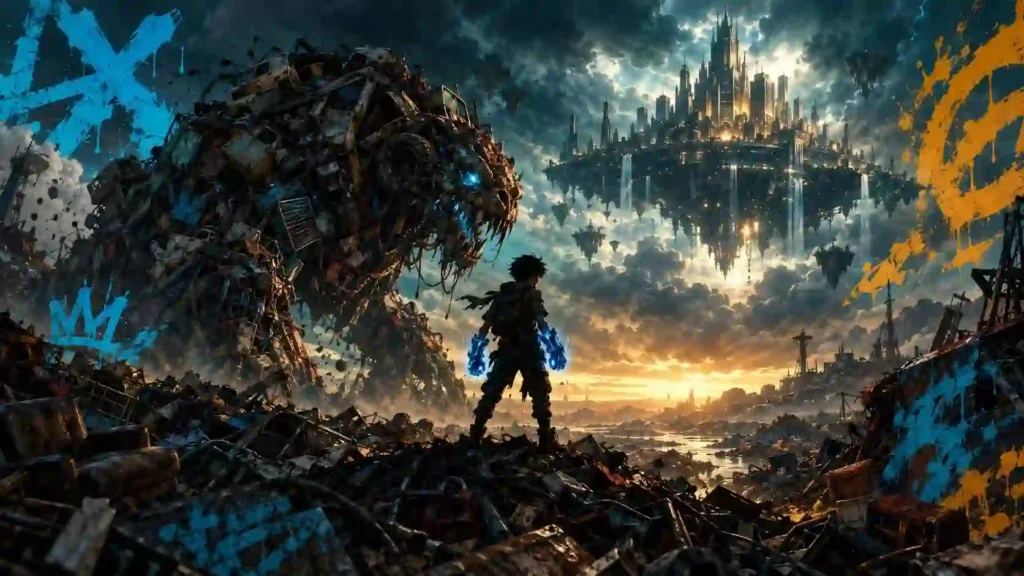
You keep seeing Gachiakuta everywhere. Your feed fills with graffiti-styled fight clips, your friends argue about Vital Instruments, and Crunchyroll keeps pushing the next episode. Still, you have no idea where the story begins, what the Pit is, or whether you should read the manga first. This guide fixes that. Below you get the full story, the characters, the power system, the reading order, and every legal place to watch or read Gachiakuta.
What Is Gachiakuta? A Quick Answer
Gachiakuta is a Japanese manga series written and illustrated by Kei Urana, with graffiti designs by Hideyoshi Ando. Kodansha has serialized it in Weekly Shōnen Magazine since February 16, 2022, and Studio Bones Film turned it into a 24-episode anime that ran from July to December 2025.
The title reads roughly as “legit trash.” Some fans type it as kigachiakuta, though the official romanization stays Gachiakuta.
The plot follows Rudo Surebrec, a teenager from the slums of a floating city. A murder frame-up sends him falling into the Pit, a wasteland of garbage below the city. There he joins the Cleaners, fighters who battle monsters born from discarded objects.
What Is the Gachiakuta Story About?
Rudo Surebrec grows up in the slums that ring a floating city called the Sphere. Wealthy Spherites drop their waste over the edge, and that trash lands exactly where the poor live. Rudo scavenges through it and resells what he finds, which earns him scorn from both sides of the wall.
His life collapses the night he finds his adoptive father, Regto, murdered in their home. Guards seize Rudo at the scene and convict him on the spot, mostly because tribesfolk like him never get the benefit of the doubt. They throw him into the Pit as capital punishment.
Rudo survives the fall because Enjin, a Cleaner, pulls him away from a Trash Beast attack. Enjin tests him, awakens his power as a Giver, and offers him a place on Team Akuta. Rudo agrees for selfish reasons: he wants the strength to climb back up and take revenge on the people who framed him.
The World of Gachiakuta: The Sphere, the Pit, and the Ground
The setting carries most of the emotional weight in Gachiakuta. Three locations drive every conflict:
- The Sphere (Tenkai). A floating structure the size of a country, split by a rigid caste. Rich Spherites live inside, while tribesfolk descended from criminals crowd the outer perimeter behind a guarded wall.
- The Pit. The endless abyss below the Sphere. Spherites treat it as both an execution site and a landfill, and they assume nothing survives there.
- The Ground (Gekai). What the Pit’s residents call their own world. Toxic, polluted, and full of scavenger civilizations that the Sphere refuses to acknowledge.
Both sides of the caste dump anything they dislike into the Pit. New items, food, furniture, and condemned people all fall the same way. That single habit keeps the Ground alive and keeps the story angry.
The border between the two worlds has a guard: the Watchman, a being so large and strange that nobody fully understands it. Its existence ties directly into the Watchman Series of Vital Instruments, which I explain below.
Who Are the Main Gachiakuta Characters?
Gachiakuta runs on an ensemble cast. These are the names you meet first:
- Rudo Surebrec. The protagonist. A scavenger with a temper and a hole where his family used to be. Regto leaves him the 3R gloves, a Watchman Series instrument that lets him bring three objects to life at once.
- Enjin. Leader of Team Akuta and Rudo’s rescuer. He fights with Umbreaker, an umbrella, and carries Time Walk, a Watchman instrument that slows his perception of time.
- Zanka Nijiku. A disciplined fighter from a noble Kamuatari District family with deep ties to the Hell Guards. His Lovely Assistaff staff turns sharp and metal on command.
- Riyo Reaper. A cheerful former hitman who wields The Ripper, a pair of scissors.
- Eishia Stilza. A shy healer who fights with Type:Heal, a black power cord, and supports her older brother August.
- Shikage. A reclusive Cleaner whose instrument casts a protective barrier over Team Akuta’s headquarters.
- Tamsy Caines. A senior member of rival Team Eager who hides cruelty behind a friendly face.
- The opposition. Amo Empool, Semiu, Guita, Noerde, Fu, Bundus, and Gris Rubion each push the story into new territory while Rudo hunts the person who actually killed Regto.
The voice casting strengthens the cast. Aoi Ichikawa voices Rudo in Japanese, and Bryson Baugus voices him in English. Katsuyuki Konishi and Christopher Wehkamp play Enjin in the two versions.
How Does the Gachiakuta Power System Work?
The fight scenes in Gachiakuta follow strict internal logic. Learn these five terms and the whole story opens up:
- Anima. Emotional energy that objects absorb from the care people pour into them. A pen you love holds more Anima than a spoon you never think about.
- Givers. People who can pull Anima out of objects and turn them into weapons. Regular guns and blades fail against Trash Beasts, so Givers do the real work.
- Vital Instruments (Jinki). Everyday objects awakened by a Giver’s attachment. The longer someone has loved an object, the stronger its instrument becomes.
- Trash Beasts (Han-jū). Regenerating monsters born from Anima that pooled inside discarded things. Only Vital Instruments can finish them off.
- Cleaners. Teams of Givers who fight Trash Beasts for pay. Team Akuta and Team Eager are the two you see most.
The Watchman Series sits above the rest. These instruments hit harder than standard gear, and they demand a price: the wielder needs to have lost something important to stay sane while using them. That rule explains a lot about Enjin’s past and about the weight Rudo carries.
Gachiakuta at a Glance: Key Facts
Gachiakuta Overview
| Category | Details |
| Title & Meaning | Gachiakuta (ガチアクタ), roughly translates to “legit trash” |
| Genre | Action, dark fantasy, dystopian |
| Creator | Kei Urana (story and art) |
| Graffiti Design | Hideyoshi Ando |
Manga Publication
| Category | Details |
| Publisher | Kodansha (Shōnen Magazine Comics imprint) |
| Magazine | Weekly Shōnen Magazine |
| Start Date | February 16, 2022 |
| Collected Volumes | 19 volumes (as of July 2026) |
| English Publisher | Kodansha USA |
| Headline Award | 50th Kodansha Manga Award, shōnen category (2026) |
Anime Adaptation
| Category | Details |
| Animation Studio | Bones Film |
| Director | Fumihiko Suganuma |
| Series Composition | Hiroshi Seko |
| Music | Taku Iwasaki |
| Character Design | Satoshi Ishino |
| Premiere Date | July 6, 2025 |
| Season 1 Length | 24 episodes across two consecutive cours |
| Season 2 Status | Confirmed (premiere date pending) |
| Primary Streamer | Crunchyroll |
Who Created Gachiakuta? Kei Urana’s Vision
Kei Urana writes and draws Gachiakuta, and graffiti artist Hideyoshi Ando designs the street art that covers its walls, weapons, and title cards. Their partnership gives the series a look that no other shōnen title copies.
Urana built the premise from a childhood memory. She owned a pen she loved, broke it in half, and remembers feeling that the broken pen was somehow pleading with her. That feeling became Anima, the emotional residue that powers every Vital Instrument in the story.
She also credits her grandmother’s dry-cleaning hangers with the idea that ordinary objects carry history. Rudo’s fighting style grows straight out of that belief: trash still holds value, and the people the world throws away still matter.
Urana’s character process surprises even her. In her own words, she designs decent people, draws them, and they come back as “freaky weirdos.” She has said she made peace with it.
The anime side recruited a crew that respects the source. Fumihiko Suganuma directs at Bones Film, Hiroshi Seko handles series composition, Satoshi Ishino designs the characters, and Taku Iwasaki scores the series. Urana has said she dreamed of watching her manga animated by Bones, the studio behind My Hero Academia and Fullmetal Alchemist. Kodansha and Bones had not worked together since Noragami nearly a decade earlier, which made this reunion a talking point in its own right.
Gachiakuta Manga: Volumes, Reading Order, and Where to Read
The manga remains the complete version of the story, and it keeps moving. Kodansha has collected 19 tankōbon volumes as of July 2026, and new chapters still appear in Weekly Shōnen Magazine most Tuesdays.
If you want to start, read in publication order. Volume 1 opens with Rudo’s life in the slums and closes with his recruitment into the Cleaners, so the series hands you its hooks early.
Your legal options:
- Print. Kodansha USA publishes the English volumes. Volume 1 arrived in January 2024, and a Dumpster Box Set collecting volumes 1 through 10 lands in Fall 2026.
- Simulpub. KManga and Kodansha’s website release new English chapters on Tuesdays, the same week as Japan.
- Japanese editions. Weekly Shōnen Magazine carries the chapters, and Pocket Shōnen Magazine hosts them online.
One scheduling note: Urana paused the manga briefly in early 2026 to recover from health issues, and the series returned to a weekly schedule afterward. The story itself contains no filler arcs worth skipping.
Gachiakuta Anime: Seasons, Episodes, and What Comes Next
Studio Bones Film announced the anime in June 2024 and premiered it on July 6, 2025. Season 1 ran 24 episodes across two consecutive cours, and the second cour adapted the Trash Storm arc in full.
Key details worth knowing:
- Japanese broadcast. The Agaru Anime block on JNN affiliates, including CBC and TBS, plus AT-X and BS NTV.
- International streaming. Crunchyroll streamed episodes worldwide from July 7, 2025, one day after the Japanese premiere. Medialink licensed the series across Southeast Asia for Ani-One Asia.
- Dubs. Crunchyroll produced dubs in English, Spanish, Brazilian Portuguese, Italian, Polish, Russian, German, French, Tamil, and Hindi.
- Awards. The series won Best New Series at the 2026 Crunchyroll Anime Awards, along with recognition for background art and character design.
Season 2 is confirmed. The staff announced it on December 21, 2025, with celebratory art from Urana and Ando, but no premiere date has landed yet. The next concrete milestone is the “Return to the Pit” panel at Anime Expo on July 3, 2026, where the cast and staff presented the first Season 2 footage.
The franchise keeps growing. A stage play opened on May 22, 2026, and a video game adaptation is in development.
What Makes Gachiakuta Stand Out? Themes, Art, and Tone
Plenty of shōnen series throw a hero into a monster-filled pit. Gachiakuta earns its audience through three choices that most titles avoid.
First, it treats waste as a moral question instead of a setting detail. The Sphere’s wealthy citizens discard perfectly good items because they can, and the Ground’s residents build entire lives out of those discards. Rudo’s rage at that inequality powers the whole plot.
Second, graffiti works as survival. Ando’s street art marks territory, hides messages, and gives the Ground’s citizens a voice the Sphere tried to silence.
Third, the tone balances the darkness. Urana draws grotesque Trash Beasts and genuinely cruel caste violence, then lets her characters be funny, petty, and warm. The series tagline says it plainly: overthrow the status quo and change the world.
Awards and Recognition: How Gachiakuta Earned Its Status
Recognition arrived quickly, and it arrived from several directions:
- Next Manga Awards 2022. Gachiakuta won the Global Special Prize in the Comics category, an early signal of its overseas pull.
- 50th Kodansha Manga Award (2026). The series took the shōnen prize, placing it beside the publisher’s most respected titles.
- 2026 Crunchyroll Anime Awards. Best New Series, plus wins for background art and character design.
- Chart presence. Gachiakuta volumes appeared on Oricon’s weekly manga sales charts throughout 2025, with sales climbing during the anime’s broadcast.
These wins matter for one practical reason. They keep the adaptation funded and the staff confident, which is why a second season, a stage play, and a game all moved forward at the same time.
Where to Watch and Read Gachiakuta Legally
| Platform | What it offers | Notes |
| Crunchyroll | All 24 Season 1 episodes with subtitles and dubs | Subscription; episodes streamed weekly |
| KManga by Kodansha | English chapters as they publish in Japan | App and web; new chapters on Tuesdays |
| Kodansha USA | English print and digital volumes | Volume 1 released January 2024 |
| Ani-One Asia | Southeast Asia streaming | Licensed by Medialink |
| Amazon Video and Apple TV | Digital purchase of episodes | Buy individual episodes or seasons |
Skip the pirate sites. They strip the creators of the numbers that fund Season 2, and the official releases cost less than a single paperback.
Frequently Asked Questions About Gachiakuta
What is Gachiakuta about in one sentence?
Gachiakuta follows Rudo Surebrec, a teenage scavenger framed for murder, who gets thrown into a garbage wasteland and joins a monster-fighting crew called the Cleaners while he hunts for the truth.
Where can I watch Gachiakuta?
Crunchyroll streams every Season 1 episode with subtitles and dubs, and it holds the license for Season 2. Viewers in Southeast Asia can also watch the series on Ani-One Asia.
Is the Gachiakuta manga finished?
No. The manga is ongoing in Weekly Shōnen Magazine, with 19 volumes collected as of July 2026 and new chapters arriving most Tuesdays.
Who is Rudo Surebrec?
Rudo is the protagonist. He is a tribesfolk scavenger, the adopted son of Regto, and a Giver whose Vital Instrument is the 3R gloves. He joins the Cleaners to find the real killer and climb back to the Sphere.
When does Gachiakuta Season 2 come out?
No premiere date exists yet. The team confirmed Season 2 in December 2025 and screened the first footage at Anime Expo on July 3, 2026. A 24-episode season usually takes Bones roughly a year to animate, so expect an announcement well before the episodes arrive.
Is Gachiakuta appropriate for younger viewers?
Gachiakuta carries a TV-MA rating, and Kodansha labels the manga 16+. It features murder, class violence, body horror, and profanity, so it suits older teens and adults better than children.
The Final Verdict: Why Gachiakuta Deserves Your Time
Gachiakuta does the rare thing. It gives you a world worth studying and a hero worth arguing with. The caste system feels grounded, the power system follows its own rules, and every Vital Instrument carries a memory that explains its owner.
Start with manga volume 1 if you want the full artwork and pacing. Start with anime episode 1 if you want the Bones soundtrack and the voice performances first. Either road leads to the same place, and both stay cheap and completely legal.
Then keep going. Read the next chapter, watch the next episode, and join the argument about what the Watchman actually is. The fans who showed up for the July panel shaped how loudly this series gets heard, and the next wave of announcements belongs to whoever stays loud.
Tell me in the comments which Vital Instrument you would wield, and share this guide with the friend who keeps spelling it kigachiakuta.