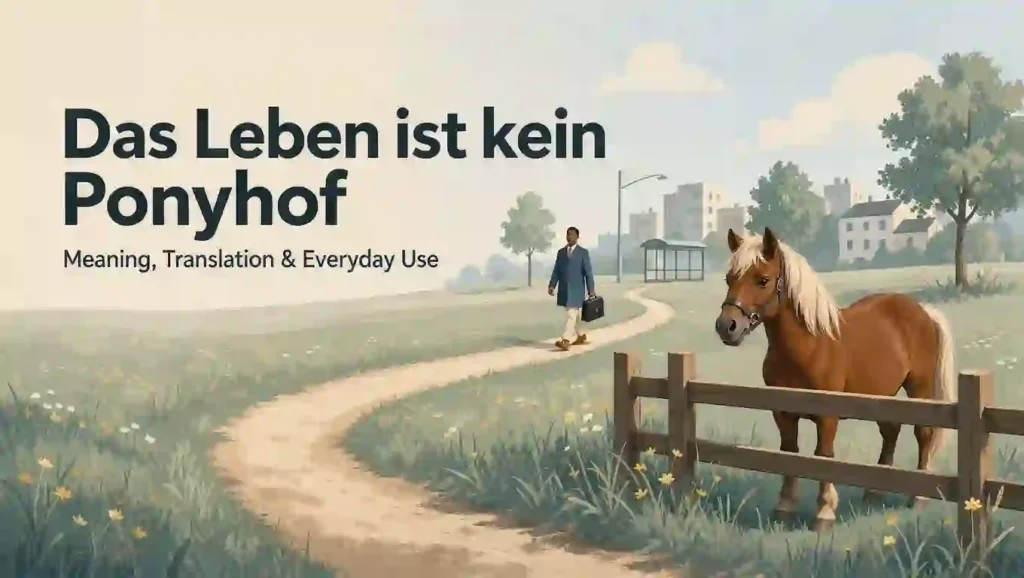
Someone says, “Das Leben ist kein Ponyhof,” and you picture horses instead of understanding the conversation. A literal translation only makes things more confusing, especially when you cannot tell whether the speaker sounds helpful or rude. This guide explains Das Leben Ist Kein Ponyhof Bedeutung in clear English, with practical translations, pronunciation tips, everyday examples, and advice that helps you use the saying without upsetting someone.
What Does “Das Leben Ist Kein Ponyhof Bedeutung” Mean?
Das Leben Ist Kein Ponyhof Bedeutung refers to the meaning of the German saying “Das Leben ist kein Ponyhof.” Its literal translation is “Life is not a pony farm.” Its everyday meaning is “Life is not always easy or enjoyable.”
The German word Bedeutung means “meaning.” It belongs to the search query, not to the saying itself.
A close English equivalent is “Life is no picnic.” Depending on the conversation, “Life isn’t always easy” or “You can’t expect everything to go your way” may fit better.
The saying reminds someone that life includes effort, disappointment, and responsibilities. However, it can also sound dismissive when a speaker uses it instead of listening.
The essential distinction: the meaning stays fairly stable, but the attitude changes with the situation.
What Is the Literal Translation of the German Phrase?
To understand Das Leben Ist Kein Ponyhof Bedeutung, start with its individual words. The sentence uses simple vocabulary, but the complete expression carries a figurative message.
| German word | Basic English meaning | Role in the sentence | Helpful explanation |
|---|---|---|---|
| Das | The | Definite article | Introduces the noun Leben. |
| Leben | Life | Subject noun | Refers to life generally, not one particular event. |
| ist | Is | Verb | Comes from sein, meaning “to be.” |
| kein | No; not a | Negative determiner | Denies that life is a pony farm. |
| Ponyhof | Pony farm | Predicate noun | Combines Pony and Hof. |
| Bedeutung | Meaning | Search-query word | Does not belong to the original saying. |
German uses das Leben where English usually says simply “life.” Therefore, “The life is not a pony farm” follows the German structure too closely and sounds unnatural in English.
Ponyhof describes a place where people keep ponies, often with riding opportunities. Duden’s dictionary entry supports this literal understanding of the noun.
That definition explains the image, but not the whole message. You need the figurative layer to understand why someone says it during an ordinary conversation.
Why Does the Saying Mention a Pony Farm?
The expression draws on an appealing picture: ponies, outdoor leisure, riding holidays, and a pleasant escape from everyday demands. It contrasts that picture with the less comfortable parts of real life.
The joke works because a pony farm seems far removed from bills, difficult decisions, or a Monday morning commute. The speaker brings someone back from an imagined easy life to a more demanding reality.
Of course, actual pony farms require serious work. People must feed animals, clean stables, maintain equipment, and manage safety.
The idiom does not offer a factual description of agricultural work. It uses an idealized image, just as “life is no picnic” does not suggest that every real picnic goes perfectly.
That difference matters for language learners. Understanding an idiom means recognizing the shared picture behind it, not proving that the picture accurately describes the real world.
What Is the Best English Translation?
The best English version of Das Leben Ist Kein Ponyhof Bedeutung depends on what the speaker wants to communicate. A good translation preserves the message and emotional tone rather than copying every word.
Use these options as a guide:
- “Life is no picnic.” A close idiomatic match that keeps the casual, slightly humorous quality.
- “Life isn’t always easy.” A clear, gentler explanation.
- “Life isn’t all fun and games.” Useful when the conversation concerns duties or effort.
- “You can’t expect everything to go your way.” Suitable when someone faces disappointed expectations.
- “That’s life.” A shorter response that can express acceptance, although it loses part of the original image.
Imagine a friend complaining about another rainy commute. “Life is no picnic” might preserve the joke.
Now imagine someone struggling with a difficult course. “Learning something new takes effort” may communicate the intended encouragement more kindly.
For subtitles, teaching materials, or professional translation, ask two questions: What does the sentence mean here, and how should the audience feel when they hear it?
How Do You Pronounce the Saying?
Pronunciation belongs alongside Das Leben Ist Kein Ponyhof Bedeutung because recognizing the words in writing does not always help you catch them in conversation.
A beginner-friendly approximation is:
dahs LAY-buhn ist kine POH-nee-hohf
Treat that spelling as a starting point, not an exact transcription. English accents differ, so the same written guide can produce different sounds.
Focus on these features:
- Leben: Stress the first syllable, with a long German e.
- kein: Use a vowel sound similar to the English word “mine.”
- Ponyhof: Put the main stress on Po-.
- Hof: Keep the vowel long rather than using the short vowel in English “off.”
- Overall rhythm: Let the smaller words move lightly between the stressed nouns.
Practice in three parts:
- Das Leben
- ist kein
- Ponyhof
Then connect the parts into one sentence. Aim for a natural rhythm rather than giving every word equal emphasis.
For a more accurate model, listen to a dictionary recording or ask a fluent speaker to demonstrate the phrase.
How Does the Grammar Work?
The grammar behind Das Leben Ist Kein Ponyhof Bedeutung is straightforward enough for beginners. The sentence follows a basic German main-clause pattern: subject, verb, and a description of the subject.
The structure is:
Das Leben + ist + kein Ponyhof
Here, das Leben serves as the subject. Ist is the third-person singular form of sein, meaning “to be.”
German uses kein to negate nouns in situations where an affirmative sentence would use an indefinite article or no article. Compare these two sentences:
- Das ist ein Ponyhof. — “That is a pony farm.”
- Das ist kein Ponyhof. — “That is not a pony farm.”
German also capitalizes nouns. That explains the capital letters in Leben and Ponyhof.
The normal sentence spelling is “Das Leben ist kein Ponyhof.” Capitalizing every major word may suit an English-style headline, but it does not reflect ordinary German sentence capitalization.
Learning this pattern helps beyond one idiom. You can recognize similar sentences even when the subject changes.
Where Does the Expression Come From?
A careful explanation of Das Leben Ist Kein Ponyhof Bedeutung should separate documented usage from claims about who invented the saying.
The Leibniz Institute for the German Language documents the broader expression etwas ist kein Ponyhof, meaning that something is not simply a pleasure. Its OWID entry classifies the expression as colloquial and places its established use around the middle of the 2000s.
The same entry discusses earlier evidence, including a 2001 newspaper reference to a Die Schröders album bearing the familiar phrase. It also discusses the German television comedy Stromberg, starring Christoph Maria Herbst, as a possible contributor to wider popularity.
These details do not establish one certain inventor. A published title, a memorable television character, and a phrase’s growth in everyday speech represent different kinds of evidence.
The safest summary is that the expression belongs to modern colloquial German. Music and television appear in its documented history, but a confident claim that one named person created it would go beyond the evidence presented here.
Is It a Proverb, an Idiom, or Slang?
You can describe the expression as a colloquial German saying or an idiom. It also resembles a proverb because it presents a general observation about life.
These labels overlap, but they highlight different features:
- Saying: A familiar expression people repeat.
- Idiom: A phrase whose intended meaning goes beyond its literal words.
- Proverb: A saying that offers a general lesson or observation.
- Colloquial expression: Language suited mainly to informal communication.
- Slang: Highly informal vocabulary, sometimes associated with a particular group.
Calling it an idiom helps learners understand why the pony-farm translation feels strange. Calling it colloquial helps them choose an appropriate setting.
“Slang” is less precise here because the expression functions as a complete saying rather than simply an informal substitute for one word.
For a classroom explanation, “an informal German idiom meaning that life is not always easy” gives readers the information they need without complicated terminology.
Is the Saying Encouraging, Funny, or Rude?
Tone forms an important part of Das Leben Ist Kein Ponyhof Bedeutung. The same words can express friendly realism, shared frustration, or a lack of sympathy.
A speaker might use the saying in three broad ways.
Friendly realism
Two friends complain about a long queue. One smiles and uses the phrase, including themselves in the inconvenience.
The shared situation makes the comment feel less like criticism. Both people face the same problem.
Self-directed humor
Someone drops their shopping bag, misses the bus, and laughs at their own bad afternoon. The expression becomes a way to acknowledge frustration without making a dramatic speech.
Self-directed use usually creates less social risk because it does not judge another person’s reaction.
Dismissive criticism
A person describes exhaustion, unfair treatment, or a serious setback. Someone responds with the saying and offers no further support.
That response can imply that the person should stop complaining. The OWID entry notes that the expression often functions as an admonition or warning.
Practical rule: use it more freely about your own minor problems than about someone else’s serious difficulties.
How Do People Use It in Everyday Conversation?
Practical examples make Das Leben Ist Kein Ponyhof Bedeutung easier to remember. The following dialogues are original teaching examples, not quotations from films, books, or interviews.
Example 1: A shared inconvenience
German:
“Schon wieder Stau.”
“Ja, das Leben ist kein Ponyhof.”
English:
“Traffic again.”
“Yes, life is no picnic.”
This exchange works best with a light tone. Neither person blames the other for feeling annoyed.
Example 2: A small household task
German:
“Ich habe keine Lust, heute noch abzuwaschen.”
“Ich auch nicht. Das Leben ist kein Ponyhof.”
English:
“I don’t feel like doing the dishes tonight.”
“Neither do I. Life isn’t all fun and games.”
The shared admission softens the remark. The speaker accepts the same responsibility rather than handing it to someone else.
Example 3: A demanding week
German:
“Diese Woche war wirklich anstrengend.”
“Stimmt. Das Leben ist kein Ponyhof. Machen wir eine Pause?”
English:
“This week was really tiring.”
“True. Life is no picnic. Shall we take a break?”
The offer of a break changes the emotional effect. It shows that realism and care can appear in the same response.
What Does the Phrase Mean in Different Situations?
Context determines whether the expression helps, irritates, or hurts. This table compares settings so you can make a sensible choice before using it.
| Situation | Likely intended message | Possible effect on the listener | Suitability | Clearer or kinder alternative |
|---|---|---|---|---|
| Friends miss a bus | Small setbacks happen | Shared amusement | Usually suitable with a friendly tone | “We’ll catch the next one.” |
| You complain about your own chores | Responsibilities are unavoidable | Self-aware humor | Usually suitable | “I’d rather relax, but this needs doing.” |
| A student dislikes routine practice | Progress takes effort | Encouragement or irritation | Depends on the relationship | “Practice is tiring, but it helps you improve.” |
| A colleague faces a busy afternoon | Work includes difficult periods | Solidarity or dismissal | Use carefully | “Let’s work out what needs doing first.” |
| An employee reports excessive workload | Work is demanding | Feeling ignored or pressured | Usually unsuitable | “Which deadlines can we change?” |
| A friend receives bad medical news | Life includes hardship | Hurt or emotional distance | Avoid | “I’m sorry. How can I support you?” |
| Someone describes discrimination | People face difficulties | Trivializing unfair treatment | Avoid | “That treatment is not acceptable.” |
| A child struggles with a new skill | Learning requires patience | Shame or discouragement | Prefer specific support | “This is difficult. Let’s try one step together.” |
| A translator explains German humor | The saying contrasts comfort with reality | Better cultural understanding | Suitable with explanation | “Life is no picnic.” |
| A formal complaint needs an answer | Not every expectation can be met | Unprofessional dismissal | Avoid | Explain the facts, responsibilities, and next steps. |
Notice that the factual message changes less than the social effect. “Life contains difficulties” may be true, but that truth does not make every use thoughtful.
A useful response should fit both the event and the person hearing it.
When Should You Avoid Saying It?
Avoid the expression when someone needs safety, practical assistance, or emotional support. A lighthearted saying cannot replace an appropriate response to a serious problem.
Particularly sensitive situations include:
- Bereavement or serious illness.
- Bullying, harassment, or discrimination.
- Severe financial distress.
- Unsafe working conditions.
- A child’s fear or significant disappointment.
- A conversation in which someone explicitly asks you to listen.
Power differences also matter. A manager’s casual remark can carry more pressure than the same words from an equal colleague.
A person may hear “life is difficult” as “I will not help you.” That risk increases when the speaker controls decisions, resources, or consequences.
You do not need to avoid humor altogether. Start by understanding the situation, then judge whether the other person welcomes a joke.
When uncertain, use a direct response: “That sounds difficult. What would help?” It communicates care without assuming that the problem needs a lesson.
How Can You Respond When Someone Says It to You?
Understanding Das Leben Ist Kein Ponyhof Bedeutung also helps you choose a reply. You can accept the joke, clarify your point, or redirect the conversation toward useful action.
If the comment feels friendly
German: “Stimmt, aber eine Pause wäre trotzdem schön.”
English: “True, but a break would still be nice.”
This keeps the exchange light while acknowledging what you need.
If you want practical help
German: “Das weiß ich. Können wir trotzdem nach einer Lösung suchen?”
English: “I know. Can we still look for a solution?”
This response avoids an argument about whether life is hard. It returns attention to the actual problem.
If the remark feels dismissive
German: “Mir geht es nicht darum, dass alles leicht sein muss.”
English: “My point isn’t that everything has to be easy.”
You can follow with a specific explanation: the deadline is impossible, the workload is unsafe, or the situation requires support.
You do not have to answer an insensitive remark with another joke. A calm statement can establish your meaning more clearly.
Which German Expressions Have Similar Meanings?
Related sayings help you understand the wider topic of German idioms about effort, disappointment, and expectations. They share parts of the message, but they do not all fit the same conversation.
Das Leben ist kein Wunschkonzert
Literal translation: “Life is not a request concert.”
Natural meaning: You cannot always have exactly what you want.
This saying focuses more strongly on wishes and preferences. It fits a situation where someone expects every choice to suit them.
Das Leben ist kein Zuckerschlecken
Literal image: Life is not the easy pleasure of licking sugar.
Natural meaning: Life is not easy.
This expression emphasizes difficulty and effort rather than the pony-farm picture of carefree enjoyment.
Das Leben ist kein Picknick
Literal translation: “Life is no picnic.”
Natural meaning: Life includes difficulties.
English speakers can understand this one quickly because English uses the same image.
So ist das Leben
Translation: “That’s life.”
This shorter expression often communicates acceptance. Depending on delivery, it can sound sympathetic, resigned, or indifferent.
Learn each phrase with a situation, not just an English gloss. That approach makes it easier to remember which expression matches your intended tone.
Can You Change the Words or Use Variations?
The saying belongs to a broader pattern: something is not a pony farm. Speakers can replace “life” with another subject to emphasize the demands of a particular activity or setting.
Examples include:
- Die Arbeitswelt ist kein Ponyhof. — “The working world is no picnic.”
- Politik ist kein Ponyhof. — “Politics is no picnic.”
- Fußball ist kein Ponyhof. — “Football is no picnic.”
The OWID entry documents this flexible pattern, while DWDS also provides evidence of figurative Ponyhof usage.
The grammar changes when the subject requires a different verb form or construction. Do not assume that you can replace every word without checking the sentence.
You may also hear nun mal added to the original saying. That wording can strengthen the sense of “that is simply how things are.”
Such additions can make a comment sound more resigned or more final. For learners, mastering the basic form first is more useful than collecting many variations.
What Common Mistakes Should English Speakers Avoid?
Several mistakes can blur Das Leben Ist Kein Ponyhof Bedeutung, even when the individual German words look familiar.
Treating “Bedeutung” as part of the saying
The expression ends at Ponyhof. Adding Bedeutung creates a search-style phrase, not the normal spoken sentence.
Using only the literal English translation
“Life is not a pony farm” preserves the image but may confuse an English-speaking listener. Explain the joke or use “Life is no picnic.”
Assuming the phrase always comforts people
Its message can encourage acceptance, but it can also criticize someone for complaining. Check the relationship and emotional setting.
Calling it proof that all Germans think alike
One idiom cannot explain an entire population’s personality. People differ in humor, habits, and attitudes toward hardship.
Claiming a definite inventor without evidence
A performer, television program, or album may contribute to popularity without creating the phrase.
Confusing realism with approval
Saying that difficulties exist does not mean that every difficult situation is acceptable. Unfairness and preventable harm still deserve attention.
These distinctions help you move from knowing a translation to using the expression responsibly.
What Does the Saying Reveal About German Humor?
The phrase offers a clear example of humor through contrast. It places the broad, serious subject of life beside the cheerful image of a pony farm.
That mismatch creates the joke. The words do not need a long story because the listener can supply the contrast immediately.
The expression can also use understatement. A speaker may face an annoying afternoon and respond as though they have discovered a grand truth about existence.
However, avoid treating this as a complete description of “German humor.” The saying illustrates one comic device, not a national rule.
You can find similar contrasts in English expressions about picnics, roses, and fun and games. Comparing these images helps language learners see that different languages often communicate familiar experiences through different pictures.
The cultural value lies in noticing the wording and its use. You do not need a stereotype to appreciate the joke.
How Can You Learn the Phrase Without Memorizing It Mechanically?
Start with one useful meaning: life is not always easy. Add the literal picture only after that meaning feels clear.
Next, connect the expression to a minor, believable situation. A rainy walk, household chores, or a missed train gives you a memorable setting without making light of serious distress.
Try this short learning routine:
- Read the German sentence aloud.
- Explain the meaning in your own English words.
- Choose a situation where the phrase would sound friendly.
- Choose a situation where it would sound insensitive.
- Write a two-line dialogue using it.
- Check the pronunciation with reliable audio.
This method teaches meaning, pronunciation, and social judgment together. Those skills matter more than repeating the sentence many times.
You can also compare two translations. Ask why “Life is no picnic” fits one dialogue while “Learning takes patience” fits another.
That comparison develops a stronger translation habit: choose words for the message, not merely for the dictionary match.
How Does This Saying Connect to the Wider Topic of German Idioms?
This expression sits at the meeting point of several useful language topics. Understanding those connections helps learners build knowledge beyond one memorable sentence.
The main related subjects include:
- Figurative language: Why a sentence can mean more than its individual words.
- German compound nouns: How Pony and Hof form one noun.
- Negation with kein: How German denies or excludes a noun.
- Informal register: When conversational expressions fit.
- Translation choices: How to preserve meaning and tone.
- Pragmatics: How relationships and situations change a listener’s interpretation.
- Modern language history: How dictionaries document changing usage.
- Empathetic communication: Why a correct translation may still create an unhelpful response.
Duden, DWDS, and the Leibniz Institute for the German Language contribute different kinds of reference material to these topics. Music and television also appear in discussions of the expression’s public circulation.
Together, these connections turn one saying into a useful entry point for learning how German works in real communication.
Frequently Asked Questions
1. What is the simplest explanation of Das Leben Ist Kein Ponyhof Bedeutung?
Das Leben Ist Kein Ponyhof Bedeutung means that life is not always easy, pleasant, or free from responsibilities. The saying literally translates as “Life is not a pony farm,” while “Life is no picnic” usually sounds more natural in English.
2. Is the expression rude in German?
It is not automatically rude. Friends can use it as a shared joke, but it can sound cold when someone describes a serious problem. Your tone, relationship, and response afterward determine much of its effect.
3. Is it an old traditional German proverb?
Do not present it as an ancient proverb. The Leibniz Institute for the German Language documents it as a modern expression, with established use around the middle of the 2000s and discussion of earlier evidence.
4. Can you use it in professional communication?
Use it cautiously in informal workplace conversation, especially about a shared minor inconvenience. Avoid it in formal complaints, sensitive feedback, or responses to workload concerns. Clear explanations and practical support usually serve those situations better.
5. Does the saying mean that happiness is impossible?
No. It says that life does not consist entirely of comfort or enjoyment. It does not claim that happiness is impossible, and it does not require people to accept harmful treatment without trying to improve their circumstances.
6. What is the safest English translation for a beginner?
“Life isn’t always easy” is the safest plain-English explanation. “Life is no picnic” is a closer idiomatic equivalent. Choose the first for immediate clarity and the second when you want to preserve the informal style.
Understand the Message, Then Choose Your Moment
The most useful lesson behind Das Leben Ist Kein Ponyhof Bedeutung is not that people should stop complaining. It is that this saying contrasts an imagined carefree life with the effort and disappointments people actually encounter.
Use it to share a small frustration, laugh at your own awkward afternoon, or recognize that a worthwhile task takes work. Leave it aside when someone needs compassion, protection, or practical help.
Try writing one short dialogue in which the expression sounds friendly. Then rewrite the same situation with a more supportive response.
If you have heard the saying in a real conversation, consider what made it funny, helpful, or uncomfortable. That context often teaches more than the translation alone.